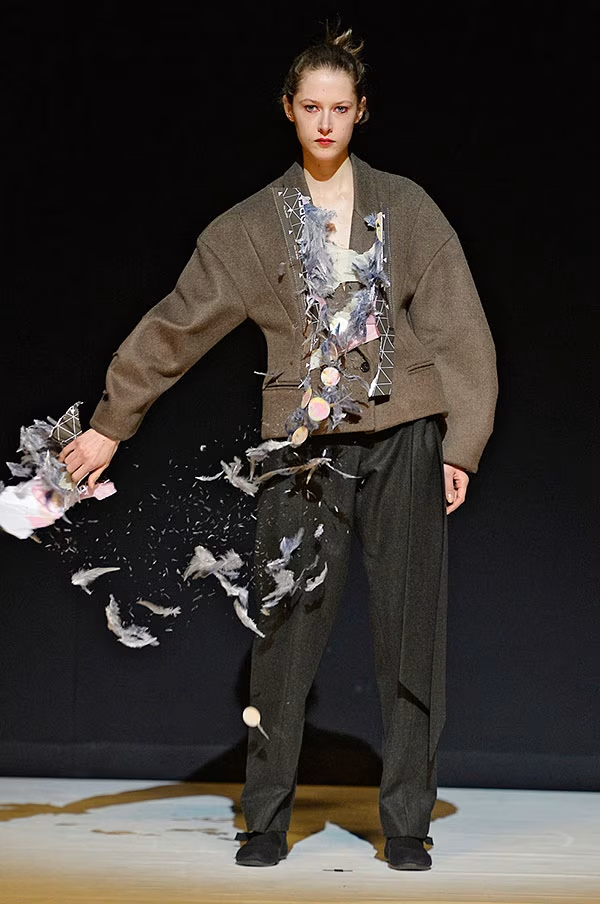
Hussein Chalayan, meanwhile, has long pushed the notion of fashion as a site of architectural and technological inquiry. His legendary table-skirt from the mid-1990s, in which a wooden coffee table unfolded into a wearable skirt, was less a garment than a manifesto: clothes could be furniture, architecture, machine. Later, his collections incorporated dresses that mechanically shifted shapes on the runway, collapsing and expanding like kinetic sculptures. Chalayan’s work speaks directly to the idea of unwearable futures, not because his garments are impossible to put on, but because they destabilise the very categories of clothing and environment. In his vision, fashion is a form of conceptual architecture, collapsing the boundary between body and dwelling, ornament and structure.
What unites these designers is not simply their interest in spectacle or impracticality, but their refusal to reduce fashion to a consumer product. In the age of fast fashion and algorithmically optimised aesthetics, their work functions as a counter-architecture, slowing us down and demanding that we see garments not as commodities but as propositions. These are not clothes you buy, wear and discard. They are provocations. They are visions of how human form might evolve, or how we might inhabit future environments where clothing and architecture are indistinguishable.
The unwearable is, paradoxically, deeply urgent. By exaggerating the sculptural and architectural possibilities of fashion, designers like van Herpen, Pugh and Chalayan challenge the limits of function and marketability. They reveal the body as a site for speculation, a kind of moving foundation upon which new worlds might be built. If architecture imagines how we live, fashion as architecture imagines how we might become. The runway becomes not just a stage for beauty but a laboratory for post-human aesthetics.
But there is also tension here. What happens when unwearable futures are inevitably aestheticised, consumed and circulated as digital images flattened into Instagram content? In the digital economy, even radical unwearability becomes consumable, absorbed into the endless scroll. A van Herpen dress may be unwearable in daily life, but it thrives as a digital image, perfect for an economy where visibility often trumps tangibility. In this sense, the unwearable is not just architectural but cinematic: garments that exist as spectacle first, object second, experience third. And yet their power endures precisely because they resist utility. At a moment when fashion risks collapsing into pure branding, these conceptual architectures remind us that clothing can still be speculative, philosophical, and radical. They insist that the body is not merely something to decorate, but something to reimagine. If buildings shape how we live, then unwearable fashion reshapes how we dream.
In the end, unwearable futures are not about impractical dresses or theatrical excess. They are about liberating fashion from its commercial function, allowing it to operate as architecture does: as a proposal for how to inhabit form, space, and self. Van Herpen, Pugh and Chalayan remind us that the future of fashion may not be wearable at all, and that might be its most radical promise.