

People often dress to be seen rather than to profess their thinkings. There is status associated with wearing something identifiable, but clothing also has the potential to lay bare something internal.
Conceptual fashion attempts this sort of vulnerability. In all of its freak and spectacle, conceptual fashion is more often paired with dialogue and self-reflection than with wearability. It approaches innovation like a probe, its designs are a reaction to the happenings around and within us.
Conceptual fashion tries to divulge something about the body rather than decorate it. Rei Kawakubo’s Comme Des Garçons has always delivered decisive kicks to fashion’s hunger for symmetry, sex, and elegance. “Punk is against flattery, and that’s what I like about it,” she says.
She’s revealed that she doesn’t get inspiration from art, or people, or travel. Instead, Kawakubo sets up a sort of mental cage for herself, where she’s not allowed to think as she usually does. She sits inside this cage, uncomfortable, waiting for an image of something undone to flutter before her. It is through this experience of pressure and limitations that her new ideas spawn. “This is the rule I always give myself: that nothing new can come from a situation that involves being free or that doesn’t involve suffering”
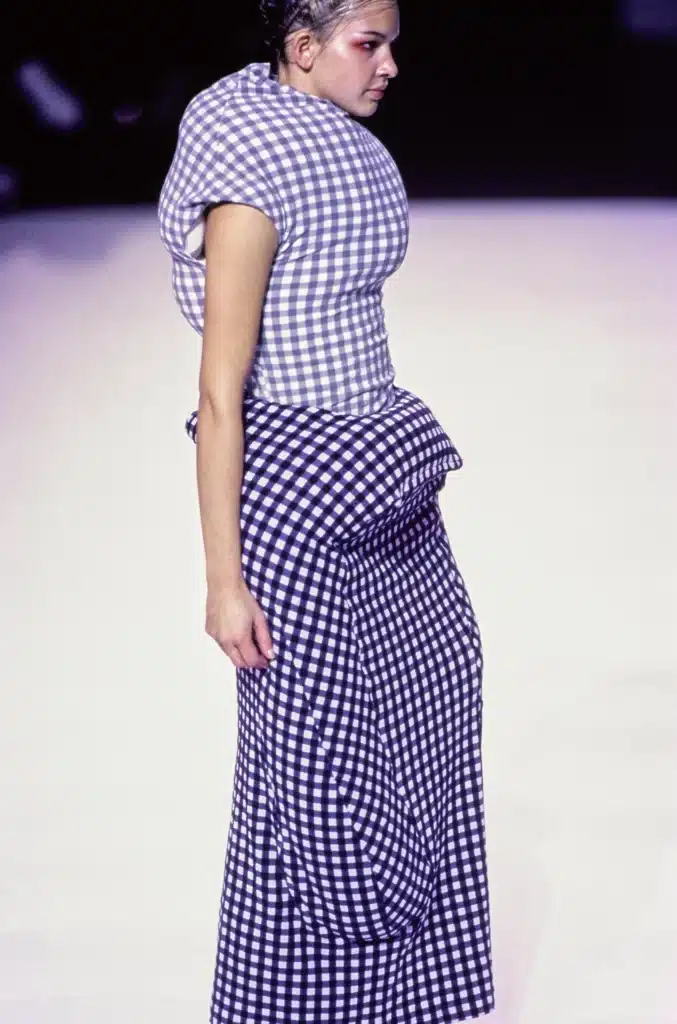

And something untapped does grow there, in that confined place. Kawakubo’s self-imposed narrowness is generative. In order to achieve a real honest statement, sometimes a silhouette must ask something of us. Maybe even something difficult.
When fashion stops trying to impress and instead seeks to solve complex internal and philosophical questions, there’s lots to explore. In that kind of world, focusing on a trend revival or celebrity endorsement becomes futile.
So, is it preferable to use fashion as a way to squeeze something real out of ourselves? To pour forth our personal inner turmoil? What happens when fashion becomes a way of thinking?
Decay, Deconstruction, and the Erosion of Meaning
We’re witnessing a sweeping preoccupation with appearing subtly fragile, decayed, and eroded. People are making and wearing garments that look undone. They’re seeking out Rick Owens-esque unraveled hems and scorched fabrics, Ann Demeulemeester’s inverted seams. They’re in pursuit of items that will create around them an aura of aging or imperfection, signalling humbleness, even simulated poverty.

Maybe this is a reaction to impermanence. A realization that what is never remains constant. Everything we build, love or rely on is destined to shift or cease. Amidst today’s extremely volatile and fast-changing landscape, permanence feels like a myth. We only ever have things as they are for a moment. The nature of social interactions is supremely digital and in flux. Now, even nature itself feels unmoored. Our natural world is slipping beyond recognition and changing irreversibly before our eyes. Amidst it all, we look on as an unchecked race for technological/political advancement claims lives and burdens generations.
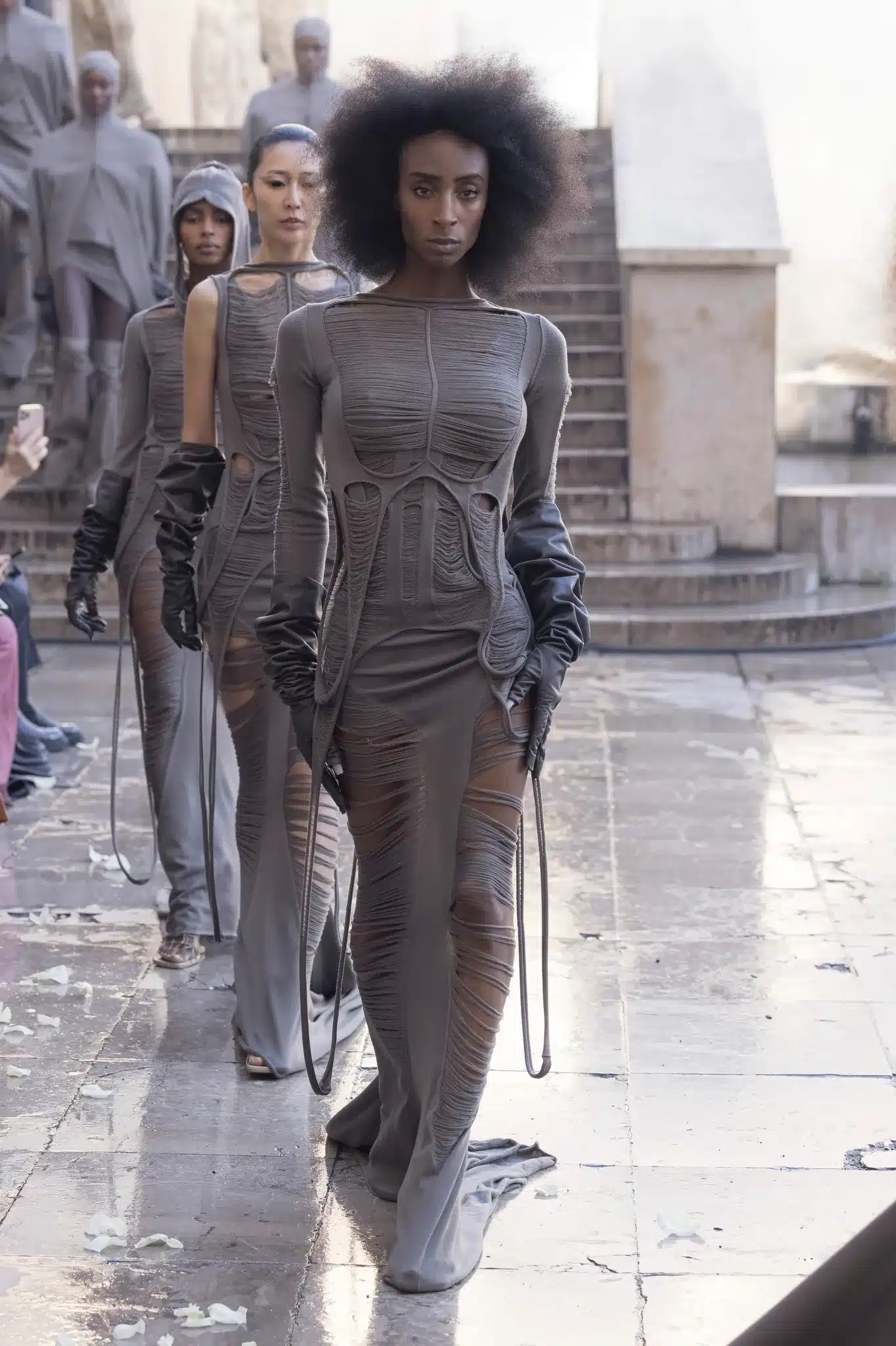


With heightened awareness of this reality, wouldn’t it be only right not to search for beauty anymore, but to try (though even this is curated) to signal empathy, to search for lull or stillness? There is a broad social feeling that perfection feels hollow and predictable in this age, and exhaustion might be taking over. Maybe what we’re witnessing, in this demonstration of rough seams and humility, is a social surrender to uncertainty.
And it’s not unique to this time period. Western fashion during the class rage of the ’70s and ’80s was often guided by the same feeling, though perhaps now the gestures arrive with less anger and more fatigue.

Jacques Derrida, philosopher and critic of Western philosophy, called it deconstruction. His deconstruction is not about fraying textiles for the sake of it, but about loosening our grip on tidy answers. Derrida says we’re excessively loyal to ideas that claim to be whole. That most of our thinking is structured around false binaries: we choose sight over touch, speech over writing, perfection over mess, one philosophy over another. He deemed true wisdom as the ability to recognize the blur between things. We must understand that most ideas are a bit confused, and being wise often means being unsure.
To live in this kind of design is to live in aporia: a state of impasse or uncertainty. In a time where almost nothing seems fixed, Derrida’s thoughts suit our moment.
Emptiness as Presence
After dwelling in aporia, we might ask what comes next. When our passion for erosion has run its course, we stand before a different challenge. What comes after decay? What do we make of emptiness?
Western way of life has a tendency to treat emptiness as a flaw. Here, creativity means filling a gap. People seek innovation through addition: more ideas, more visibility, by any means necessary. More attempts to be real by association. More function – any open space must be climbed and occupied.
But other philosophies tell us that this gap itself is sacred.
Zen Buddhism and Mahāyāna thought seem to propose that absence itself generates things. At the center of these teachings is the belief that emptiness is the ultimate reality, and that truth reveals itself in stillness, in silence even. The Doctrine of Emptiness (śūnyatā) and pratītyasamutpāda teach that nothing exists outside of context and interaction. Essentially, emptiness isn’t really empty at all. There is something alive during a hyperconscious pause in conversation, in a glance exchanged during shared witnessing, in a chipped tea bowl, in the sitting of an immovable rock. Emptiness is not a lack, but a presence.

This idea also finds its expression in revered Japanese concepts like wabi-sabi, the appreciation of imperfection, impermanence , and decay, and ma, where the empty space between trees is as meaningful as the trees themselves. Ma teaches that emptiness is not a void to be filled. In fact, it is emptiness that shapes and defines what surrounds it.
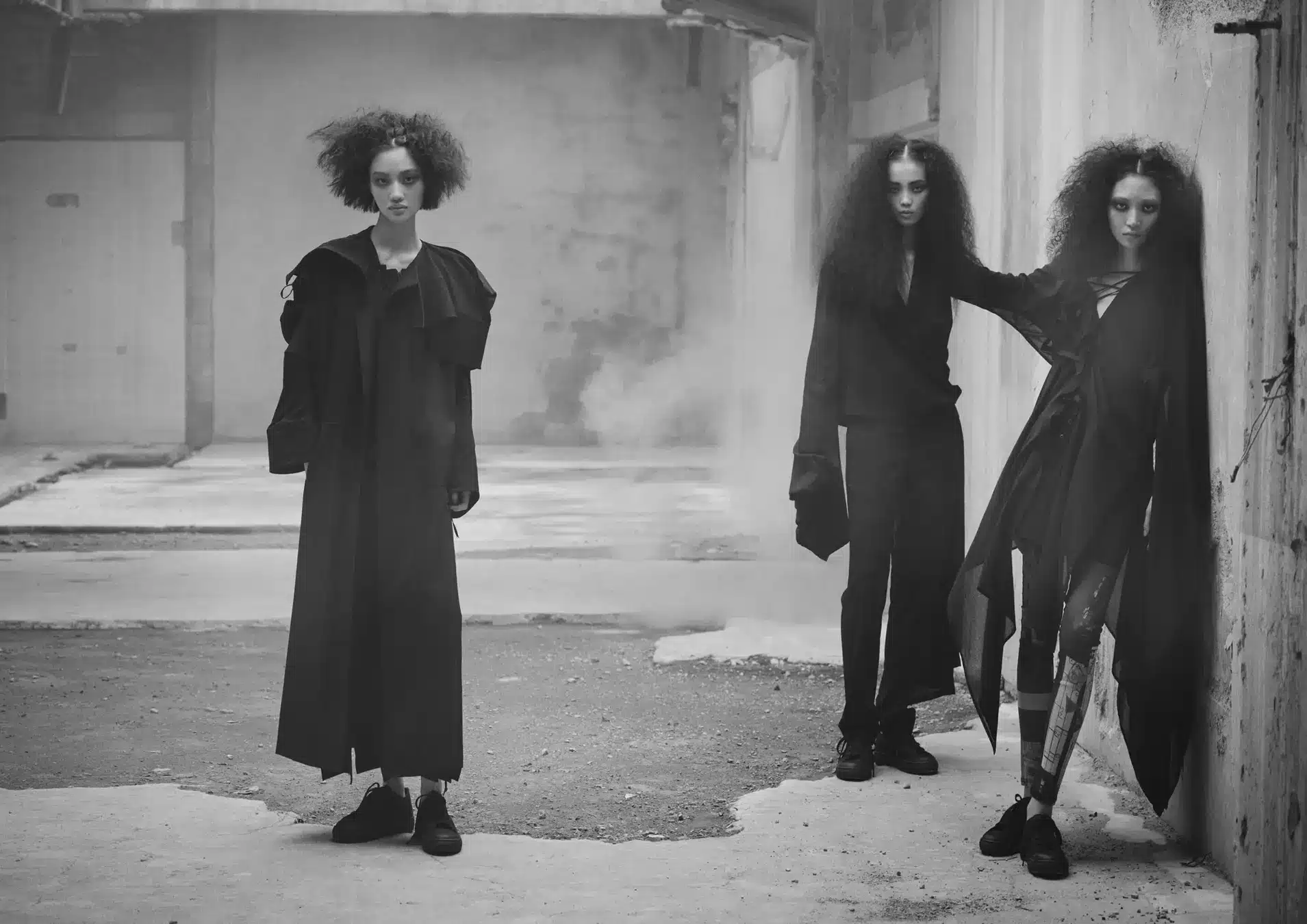
Fashion too, can act this way. Yohji Yamamoto once said, “I think perfection is ugly. Somewhere in the things humans make, I want to see scars, failure, disorder, distortion.” His contemplative designs are often draped, frequently asymmetrical, and consistently reject superficiality. He does not want to subtract meaning from the clothes, but he chooses to understate them so that meaning can emerge.


Fashion as Unconcealment
We benefit from learning – as German philosopher Martin Heidegger would remind us – that there is something grand in the nothing. In his turn at the philosopher’s game (truth-seeking), he begins with the idea that most of us, most of the time, have simply forgotten to notice that we’re alive. We crank on, most days acutely unaware of the intrigue and mystery that is possible for us. We forget our interconnectedness, we forget to question things, and by doing this we hide from a confrontation with the ever-looming ‘nothing’ (das sein, he calls it). Heidegger wants us to hurry up and take notice of the precious, limited time we have to be beings, before the inevitable ‘nothing’ claims us– which it will for us all, in time.
He discusses our ‘thrownness’, or geworfenheit, the idea that we are hurled through life, immediately surrounded by calcified social attitudes and paths not of our own making. The lucky few who become aware of their thrownness and overcome it somehow are able to escape the uneigentlichkeit (inauthenticity) that plagues so many. Most of us never succeed at this task.
So, for Heidegger, the truth is the unforgetting, the unconcealment. It is the process by which things reveal themselves as they are, undisguised and unsteered. The important things (e.g., looming death) are remembered, and so authenticity prevails. The daunting ‘nothing’ that we generally hide from, which keeps us drifting through paths we never wanted to forge, is actually what we should run towards, what we should keep clearest in our minds.
In The Origin of the Work of Art, Heidegger says, “The work of art lets truth happen. It sets up a world and sets forth earth.” He’d propose that fashion should be used as a dialect of truth, to disclose what we experience during this trek towards authenticity.
Fashion, then, becomes an act of unconcealment. It makes clear the appearance of things in the world, communicating what these things mean for human beings.
Can You Wear What You Don’t Live?
As philosophy is typically inclined, each truth only leads to more questioning.
We see now that conceptual fashion thinks, decays, mirrors the world and disappears into it all at once. We know that conceptual fashion is a signal. But who are we signaling to, and is that signal any less performative than mainstream fashion? To some degree, performance is performance no matter how you cut it. And yet, maybe it’s better to signal something to the select few who share your own philosophy. After all, it’s usually more powerful to be truly valued by few than to be vaguely recognized by most. So in that way, the conceptual and the avant-garde are more pointed ways of communicating.
Conceptual fashion uses clothing for truth-seeking. Designers who aim to say something meaningful have philosophies of their own and their work becomes an emblem of that intent. Avant garde and conceptual fashion may resist mass appeal, but that doesn’t mean they are free from the desire to be perceived. Some people who wear these emblems might wish to be seen as close to that philosophy. But this is different from truly understanding the philosophy or having one of their own.
Many conceptual brands are expensive, inaccessible, and fetishised. Which raises another question: is there a more faithful embodiment of a philosophy in not purchasing it, in choosing to invest elsewhere – in self, people, or experiences, for example? Maybe the most palpable expression of wabi-sabi or Zen is found not in outward display, but in restraint. Surely, we can represent a philosophy without buying into it.
Surely, having your own idea of what to say matters more. You don’t want to be trapped in uneigentlichkeit – in adopted gestures, inherited opinions. It’s easy to borrow identity. But to get to true eigentlichkeit, reaching max authentic living, clothes are not enough.
A message to the fashion-minded: you might connect better with someone who has never heard of your favorite designer than with someone who shares all your tastes. This lesson is easily lost. More and more, people are constructing themselves from references instead of reflection. Wearing and portraying things they have not lived.
We’re free to use fashion as a method of knowing, but it can quickly become an aesthetic shortcut to identity. Fashion sometimes forgets that persona is not real.
Fashion as philosophy brings us to our most pressing, personal questions. Can you inspire people outside of persona? Outside of validation seeking? What small moments do others have with your inner world? Though art and inspiration are powerful, and in some ways you are what you consume, there is another, more real thing to a person.
We must not lose sight of the other thing. Though you might be wearing an idea, are you living it?
“But for the present age, which prefers the sign to the thing signified, the copy to the original, representation to reality, appearance to essence … truth is considered profane, and only illusion is sacred.. the highest degree of illusion comes to be the highest degree of sacredness”
Feuerbach I Preface to the second edition of The Essence of Christianity
Credit:
Written by Zaina Pakabomba