

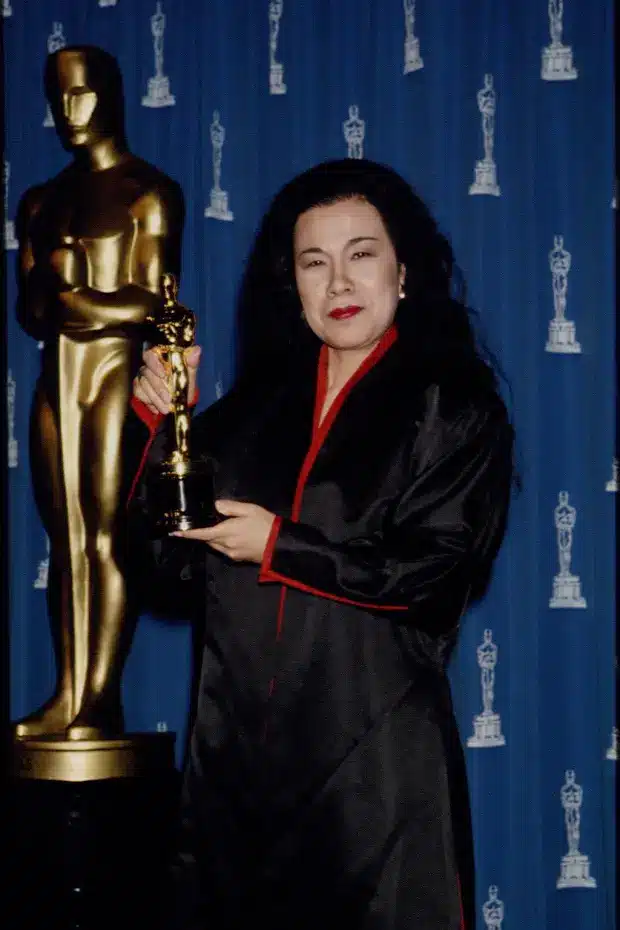
July 12 marks what would have been Eiko Ishioka’s 87th birthday. Born in Tokyo to a graphic designer father, she was, despite her creative upbringing, discouraged from following him into the business. Instead, she studied at Tokyo National University of Fine Arts and Music. Her first professional job was in the advertising division of Shiseido in 1961, and four years later, at age twenty-seven, she became the first woman to win Japan’s most prestigious advertising award.
“One man, a very talented designer, said that my name would not be famous if I were not a woman,” she recalled years later. “It made me angry.”
As a result, she was commissioned to design commercials for Parco, an upscale Japanese department store, where she would become chief art director. Her involvement with Parco lasted throughout the seventies, and her surreal and erotic campaigns, with a distinctive style anticipating what was to come, often featured Faye Dunaway at the peak of her fame. During her tenure, she worked on 1977’s Fly with Issey Miyake show, where she oversaw stage, lighting, music, advertising, and video. At the end of her contract, in 1983, Ishioka opened her own design company.
Around that time, American filmmaker Paul Schrader chose her as art director for his epic Mishima: A Life in Four Chapters, which premiered at Cannes, where it earned her a special award for artistic contribution. This was a match made in heaven, as there was no one more fitting to translate the controversial Japanese writer’s universe into moving images.
Ishioka’s work on the Japanese poster for Francis Ford Coppola’s Apocalypse Now led to her collaboration with him in 1992, this time designing the costumes for Bram Stoker’s Dracula. For a film so reliant on wardrobe rather than set design, this was no small feat. Ishioka was given great creative control and, borrowing from atypical sources such as Gustav Klimt’s paintings, she created several now-legendary designs: Dracula’s red armor, reminiscent of human muscles, a motif she would revisit later in her career, the old count’s sculptural hairdo, and Lucy’s reptilian wedding dress, just to name a few.

The film won her a much-deserved Academy Award and opened the door for further Hollywood collaborations. The most memorable of these was The Cell, directed by Tarsem Singh, known for music videos such as R.E.M.’s “Losing My Religion” and, more recently, Lady Gaga’s “911.” The 2000 sci-fi horror film starred Jennifer Lopez as a social worker who, with the help of a group of scientists, enters the mind of a comatose serial killer, played by Vincent D’Onofrio, in order to discover where his last kidnapped victim is hidden. While not a critical success, critics compared it unfavorably to The Silence of the Lambs, the surreal visual elements, once again inspired by artists such as Damien Hirst, Odd Nerdrum, and H. R. Giger, received praise upon release, and the film has since become a cult classic.
Ishioka’s contribution featured masks, horns, capes, wings, and a reintroduction of the red muscle armor from Dracula, this time as the suit Lopez’s character wears to enter the killer’s mind. Another famous scene shows her characterized as a figure reminiscent of the Virgin Mary, although director Tarsem Singh has stated that the actual influence was a Brazilian water goddess. The costumes and elaborate imagery upstaged the film’s story and performances. Much like in Dracula, Ishioka’s designs became sets in their own right; sculptures to be worn.

After The Cell, Ishioka collaborated on other Tarsem-directed films such as The Fall, Immortals, and Mirror Mirror, which would mark her final big-screen credit. This 2012 Snow White adaptation starring Lily Collins and Julia Roberts earned her a posthumous Oscar nomination and saw her designs enter full-on baroque fairy tale territory. While her signature blood red remained present in the Evil Queen’s gown, she opted for less aggressive designs of Elizabethan inspiration and a more colorful palette, incorporating whites, golds, yellows, bright oranges, and blues.

Besides film and advertising, Ishioka also directed the music video “Cocoon” for Björk and excelled in stage work, designing costumes for the Broadway play M. Butterfly, Wagner’s Der Ring des Nibelungen for the Dutch Opera, Cirque du Soleil: Varekai, the Broadway musical Spider-Man: Turn Off the Dark, and Grace Jones’ Hurricane tour.
Besides film and advertising, Ishioka also directed the music video “Cocoon” for Björk and excelled in stage work, designing costumes for the Broadway play M. Butterfly, Wagner’s Der Ring des Nibelungen for the Dutch Opera, Cirque du Soleil: Varekai, the Broadway musical Spider-Man: Turn Off the Dark, and Grace Jones’ Hurricane tour.


Sadly, Eiko Ishioka died of pancreatic cancer on January 21, 2012. But her influence is still palpable today. Quite evidently, her work must have fascinated Viktor & Rolf, whose Autumn/Winter 1999 collection, titled Russian Doll, echoes Dracula’s tunics and Mina’s green dress, and inspired the Brazilian Lino Villaventura’s theatrics. And what to say about the late Alexander McQueen, whose Voss collection, created for Spring/Summer 2001, was shown shortly after The Cell came out and presents uncanny parallels with the film’s themes, costumes, and sets: insanity, the natural world, bodily perfection, taxidermy birds, all laced with Orientalist and surrealist elements. The show was staged inside a mirrored box, which only became transparent to the audience an hour after the supposed start, revealing a padded room like a mental asylum cell. The palette consisted mostly of muted colors, except perhaps for the closing look: a skirt made of red and black ostrich feathers and a bodice made of microscope slides painted red. At the end, a box in the center of the room shattered, revealing writer and plus-sized model Michelle Olley, nude and covered in live moths, lying on her side with a winged mask connected to a breathing apparatus, a reenactment of a photograph by Joel-Peter Witkin.

But this is far from the only time Eiko Ishioka’s influence appears in McQueen’s work. His Autumn/Winter 2008 collection, titled The Girl Who Lived in a Tree, with its British-Indian elements, fairy tale inspirations, red satins, and Philip Treacy headpieces, seems reminiscent of Ishioka’s multiple collaborations with the Indian-born Singh.
With Lee McQueen sadly gone as well, one wonders who might be today’s heir to Ishioka’s legacy. While there is certainly no need, or way, to replace her, Iris van Herpen, who just presented her breathtaking Autumn/Winter 2025 collection in Paris, probably comes the closest: thanks to her unique approach to fantasy couture, her use of 3D printing reminiscent of Ishioka’s textures, her natural tendency toward innovation, and her blurring of boundaries between nature and technology. Her digital-surrealist creations are far more than mere fashion garments; they are wearable art.

The same applies to Eiko Ishioka’s bold cross-disciplinary masterpieces. From designing the Grammy-winning artwork for Miles Davis’ Tutu in 1987, to the costumes for the 2008 Beijing Olympics opening ceremony, everything she touched became infused with her mysterious yet magical personality and passion. As we look back on Ishioka’s legacy this July, it feels more relevant than ever. In an era where fashion and cinema increasingly merge with digital technologies and immersive art, her work stands as a timeless reminder that true innovation always begins with radical imagination.
Despite her global status, Ishioka remains an underrated icon whose influence still breathes life into contemporary fashion. As she once said, to create something truly original: “It’s important to never follow what’s in fashion.” She never did, but fashion certainly followed her, and still does today.

Credits:
Written by Nacho Pajìn @nachopajin