Published on October 28, 2026

Can You Wear the Sacred Without Believing in It?

Growing up, a cross wasn’t a symbol. It was an accessory, somewhere between hoop earrings and a good belt.

Girls at school wore it as earrings, as a thin gold chain disappearing under a jumper, as a print on whatever H&M had dropped that week. Some necklines went further: a crowded crew-neck of charms, the hamsa, the Star of David, the Christian cross, worn together, indifferent to the fact that none of these histories agree with each other. For a few strange seasons in the early 2020s, a scarf tied a certain way stopped being about modesty and became a trend, its debt to the Muslim veil acknowledged nowhere, or almost.

Hand amulets, North Africa, Collection & Photo Collection from Van Dam-Canton, Qilada Foundation.

None of it registered as a question back then. It just was, the same way jewelry is jewelry, the way fabric is fabric. But sacred imagery doesn’t behave like other images, because it was never made to be looked at. It was made to be believed. Which leaves the current situation with a debt nobody’s paying: fashion keeps cashing checks written by faith, and faith was never asked to co-sign.

So the question isn’t rhetorical. It’s structural. Can you wear the sacred without believing in it, or does wearing it, no matter the belief, always mean something?

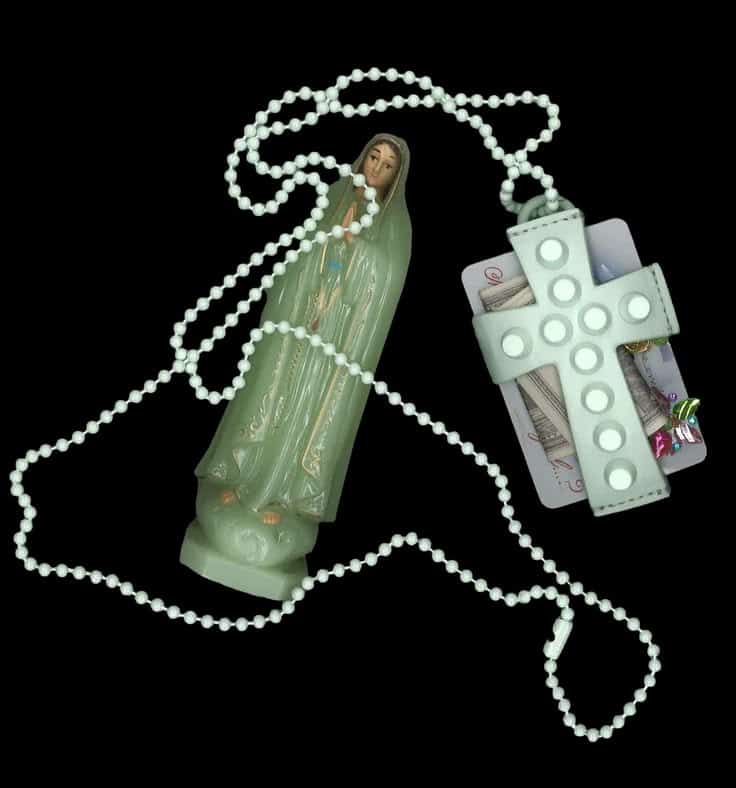
Cross Stud Strap Wallet from Sculptor.

I. Does fashion borrow from religion, or has religion always been fashion’s first client?

Fashion didn’t discover the sacred. It was raised by it.

Long before the idea of trend existed, clothing served one purpose: to show who had the right to approach the divine, and how far. The priest’s alb, the bishop’s mitre, the nun’s veil. Each of these garments was a vow, not a look. And long before fashion existed to copy it, the Church had already invented spectacle: gold, incense, procession, silence held at exactly the right moment. All of it built to produce awe in whoever was watching.

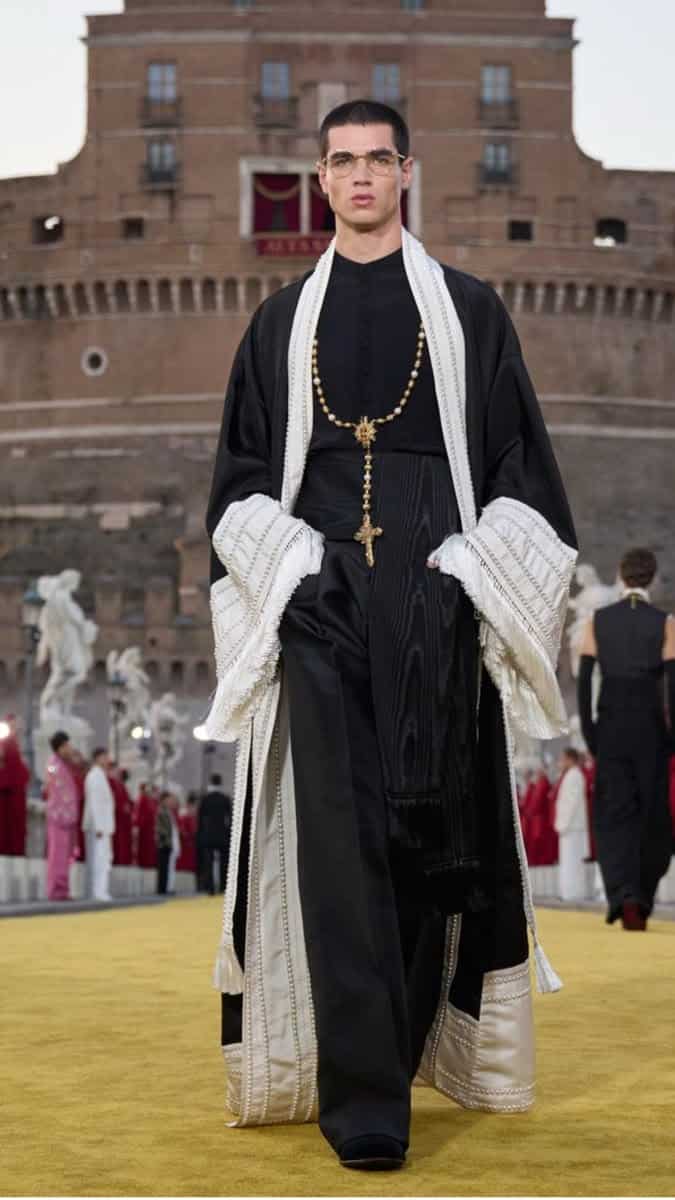
Fashion kept that exact mechanism. The runway replaced the aisle. The front row plays the role of the congregation. The show is the mass, wearing a different name. Dolce & Gabbana’s Fall 2013 collection made the link almost literal: dresses printed with the gold Byzantine mosaics of Sicily’s Monreale Cathedral, saints and angels lifted straight off the walls of a church built in the twelfth century. Twelve years later, for their 2025 Alta Sartoria show, the house pushed the metaphor as far as it can go: forty men dressed as bishops, in real ceremonial red, lined a bridge in Rome while the models walked past them like a procession heading toward an altar. The runway didn’t reference the church. For twenty minutes, it borrowed its entire cast.

Dolce & Gabbana Fall/Winter 2013 “Monreale Mosaic Runway”
Dolce & Gabbana Alta Sartoria 2025 (Ponte Sant'Angelo, Rome)

So when fashion “borrows” from religion, it isn’t reaching for anything new. It’s coming home. It takes back what, once, meant something, and leaves that meaning at the coat check, the way you leave a coat at the door.

II. Who gets to wear it, and when does it become a problem?

The line isn’t drawn on the object. It’s drawn on what that object still costs the person wearing it.

A crucifix worn by a grandmother who says her rosary every night and a crucifix worn by a model who’s never set foot in a church are not the same object, even cast from the same gold. One still carries risk, obligation, belonging: cross a line and answer for it in front of a parish. The other carries none of that. It carries only the aesthetic residue.

The cross is not the only religious item fashion has borrowed, but the veil works a bit differently. That’s the real test, more useful than asking who’s “allowed”: does the wearer still answer for something by wearing it? A veil worn by a Muslim woman can answer to many, deeply personal reasons: faith, modesty, belonging to a community, a political choice made in defiance of a state that bans it, or conversely a rule that imposes it. While wearing a cross necklace today is mostly a personal style choice in Western fashion, wearing a veil often comes with legal bans, political debates, or safety risks for many women. Those reasons are never the same from one woman to another, and none of them fit into a single box. What connects them is that, for these women, the veil is tied to something real. A veil worn as a single-season runway motif is tied to nothing. It can be taken off by October.

This is where it turns: it’s no longer borrowing, it’s taking. Taking the image without ever paying what gave that image its original weight.

Beaded rosary veil with silver crosses, via valenwav/Instagram
John Galliano for The House of Dior, Spring Summer 2006, Haute Couture

III. Cross, veil: same gesture, different weight

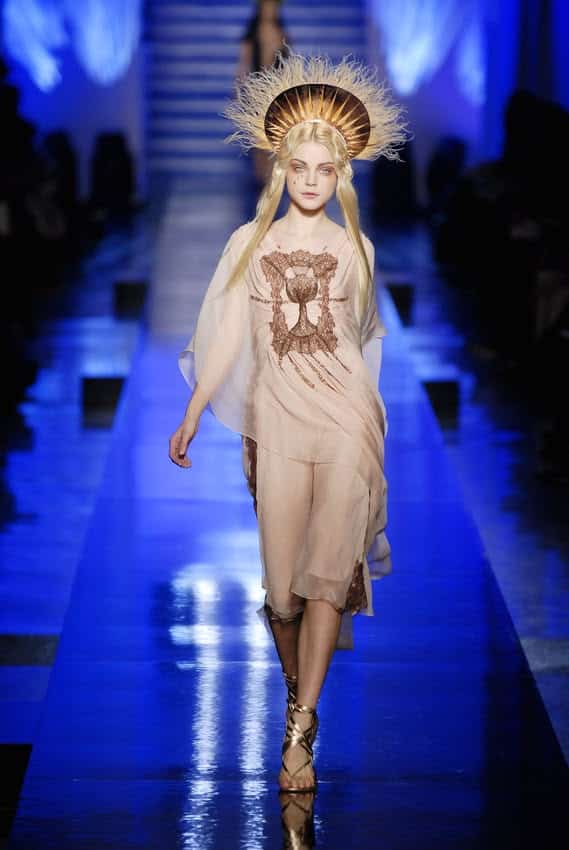
The cross. Follow its fall, from an instrument of crucifixion to a charm on a bracelet, and the register shifts completely depending on who’s wearing it and against what. Madonna, in the 1980-90s, didn’t neutralize the cross: she turned it into a weapon, Catholic guilt flipped into provocation, rosaries worn as bondage gear. As seen in her Blonde Ambition Tour, she takes sacred symbols and places them directly into pop performance. That’s blasphemy, and blasphemy needs belief to function: you can’t offend a god you never think about. Jean Paul Gaultier went the other way entirely with his Spring 2007 haute couture show, “Virgins (or Madonnas)”: stained-glass prints, gold halos, models styled after Baroque Madonnas—the whole collection built less like provocation and more like devotion, an atheist designer building an altar out of pure craft. Riccardo Tisci, at Givenchy, sat somewhere in between: Christ prints across menswear, crucifix chains piled on couture gowns, incense burning backstage before every show—a Catholic childhood he never fully left, worn as much as designed. Compare any of that to a cross worn today because “grunge is back”—no church behind it, no guilt to spend, no altar to build. Some of these are a fight with religion, or a conversation with it. The last one doesn’t know religion is in the room.

Madonna during the Blonde Ambition Tour, wearing a cross necklace 1990.
Jean Paul Gaultier Spring/Summer 2007 Haute Couture
Riccardo Tisci for Givenchy Spring/Summer 2016, Kevin Tachman, Vogue
Givenchy, Ready to Wear Collection Spring/Summer 2016

The veil. Hijab, chador, mantilla, the Western bridal veil: four garments, four entirely different relationships to modesty, choice, and inheritance, routinely flattened into a single silhouette on a moodboard. During the Fall 2018 shows, hijab-shaped head coverings turned up on runways in Milan and Paris, at Gucci, Versace, and Balmain among others, tied under the chin or draped close to the scalp, worn almost entirely by models who weren’t Muslim, with no mention of the hijab anywhere in the show notes. Some collections drawing on religious or precarity-coded dress have been read, by some, as aestheticizing what, for millions of women, is a matter of faith, of family heritage, or sometimes of constraint, none of these situations alike. Compare that to the 2020s scarf-headband: the shape of the hijab, none of what it carries, resold as “effortless.”

Same fabric, opposite gravity.

Gucci, Fall Winter 2018
Versace Fall Winter 2018, Backstage Runway

Conclusion

Maybe the honest answer is neither yes nor no. Maybe fashion was never equipped to answer this question, because its only real function is to empty a form of its weight so it can be worn by anyone. It does this to everything, not just religion. Black once carried mourning, now it carries elegance. The uniform once carried authority, now it carries a head-to-toe look. Protest once carried the street, now it carries an entire aisle in a store. Sacred imagery only makes that emptying more visible, because the original was never built to survive it.

Rihanna’s papal look at the 2018 Met Gala, standing next to the actual liturgical garments it was borrowed from, made the whole argument literal: the shape of the Church, worn by someone who owes it nothing.

So: can you wear the sacred without believing in it? Yes. But understand, in doing so, that what you’re wearing is no longer the sacred.
It’s the shape it left behind.

Maison Margiela’s Papal Look for Rihanna 2018 Met Gala.

Credits

Written by Noa Chantemerle @noalitaa

Cover: Honor Fraser for Alexander McQueen Fall/Winter 1996 Ready-to-Wear

Welcome

E-mail
Password

E-mail *
First Name *
Last Name *
Age *
Gender *
Country *
City *
Phone Number *
Password *
Confirm Password *

E-mail
New password
Confirm new password