Scrolling on social media has become a reflex, comparing, consuming and absorbing. But in this chaos of images, something sometimes breaks through. Not just something beautiful, but something that disturbs us, something that stays.
What if this reaction pointed toward something deeper? A growing desire to move away from what is given. A refusal of the “natural” body as a final state.
In fashion, the body isn’t natural; it’s constructed, transformed and sometimes made unrecognizable. From hair color to the most extreme physical modifications, it becomes a surface of projection, a space for experimentation. A form of near-total customization, as if identity itself could be designed.
But this transformation is not new. For centuries, clothing and ornament have been used to transcend the body, to move away from something raw and organic toward something elevated, almost divine.
What has changed is the nature of this transformation. It no longer aims to enhance the natural, but to detach from it entirely.
The less human the body becomes, the more it starts to feel sacred.
But what attracts us to a non-human aesthetic?
In fashion, the post-human body is not necessarily technological. It is a body pushed beyond recognition.
Through clothing, the silhouette can be erased, distorted, or rebuilt. Proportions shift and volumes expand. The body is no longer fixed, but becomes an abstract composition.
It isn’t about enhancement anymore; it’s about self-construction.
This transformation takes different forms.
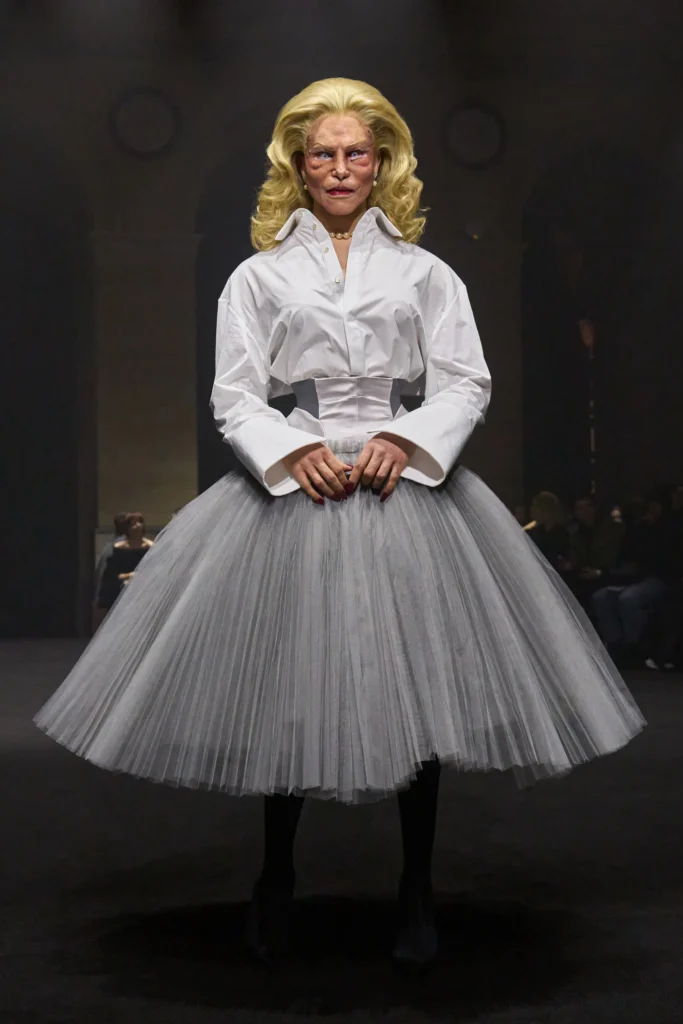
The body can be distorted through prosthetics, exaggerated volumes, or extreme silhouettes. In the work of Jordan Arthur Smith or Demna for Balenciaga, proportions lose all sense of realism. The silhouette becomes unstable, almost impossible to read.
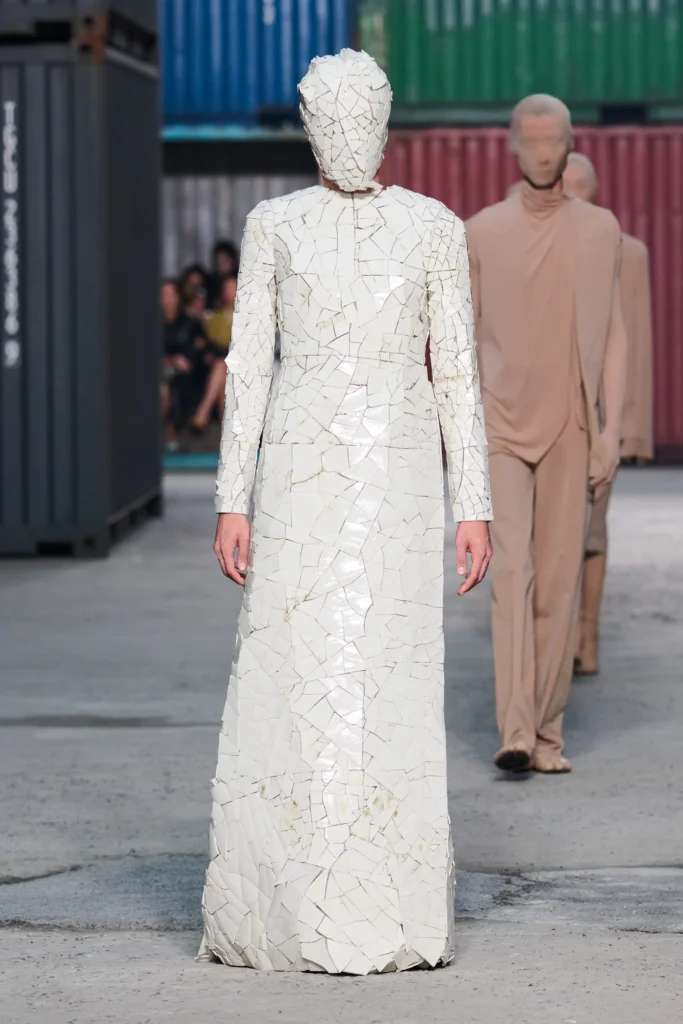
It can disappear: faces are hidden, identities dissolve, features are neutralized or exaggerated through makeup. The human figure becomes unstable, suspended between presence and absence. What remains is no longer entirely human, but something projected onto this notion.
The silhouette can be augmented, hybridized with materials and digital references. At Diesel SS25, bodies appeared as avatars, reflections of a self that exists somewhere between physical and virtual.
Projects like Matières Fécales push this even further, turning the body into something almost unrecognizable.
The body is no longer a given form, but a blank canvas shaped by intention.
In distortion, the body becomes something else entirely. Take the work of Thom Browne for instance. Proportions are exaggerated, displaced, often deliberately illogical, creating a silhouette that no longer follows human logic. This loss of reference creates distance, and it’s precisely this distance that produces a form of sacredness. What is distant becomes harder to grasp, almost untouchable.
In disappearance, the dynamic reverses: the body does not transform, it fades. Faces are hidden, silhouettes become uniform, materials absorb the light. The individual dissolves into a more abstract form. The less we recognize the human, the more we project something else onto it: an idea, a symbol, almost like a spiritual presence.
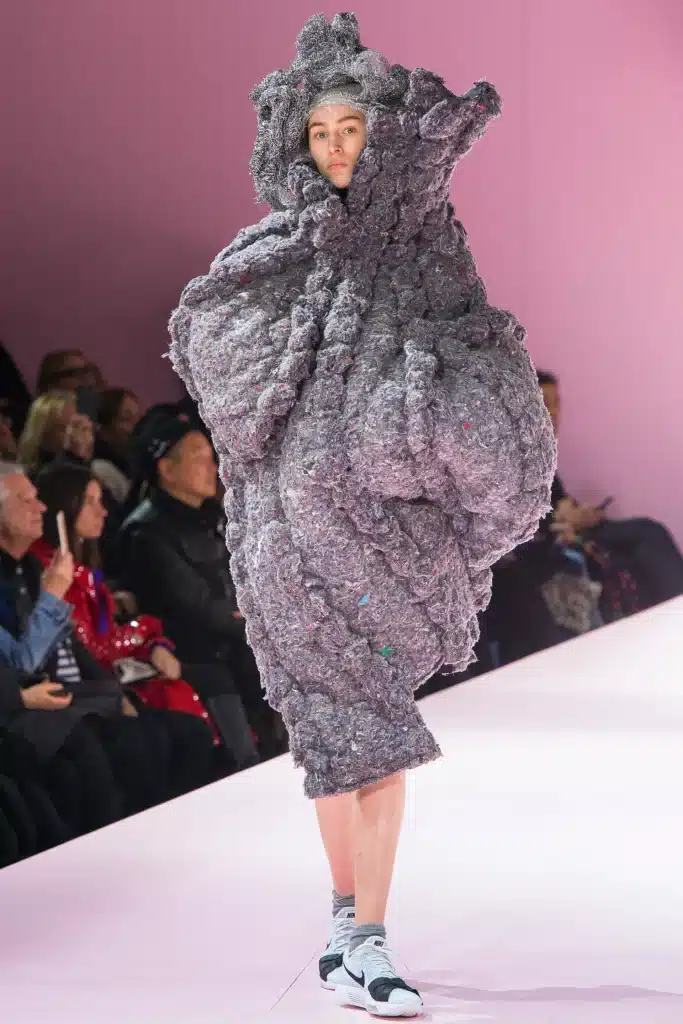
In augmentation, the figure becomes more than itself. It is extended, amplified, hybridized with external elements. It is no longer simply dress, the garment becomes a structure, an extension, sometimes even a constraint. The body is fabricated, it becomes a constructed shell.
What is at stake here goes beyond aesthetics.
For a long time, the sacred was associated with what was pure, natural, intact. The ideal body was harmonious, balanced, close to a form of organic perfection. Today, this relationship is reversing. Sacredness no longer emerges from what the body is, but from what it becomes: it no longer relies on essence, but on transformation. A body that is too human is understandable, accessible, and therefore ordinary. A transformed, altered body creates distance, and it is precisely that distance that produces a form of sacredness.
Fashion no longer seeks only to dress the body. It distances it, redefines it, displaces it. It no longer presents a stable identity, but a process. The physical form becomes a language, a medium, almost a fiction.
And perhaps, within this loss of reference, within this departure from the “natural,” something new emerges. Something no longer entirely human, yet, paradoxically, something higher.
Almost divine.