

Inside a horse stable, silence settles after the final act of care. A man emerges from a stall where he has just put down the last remaining horse. He hangs a blood-stained towel over the stall door and slowly walks through the narrow corridors. His movements are hesitant and detached, suggesting someone struggling to comprehend the irreversible act he has just performed.
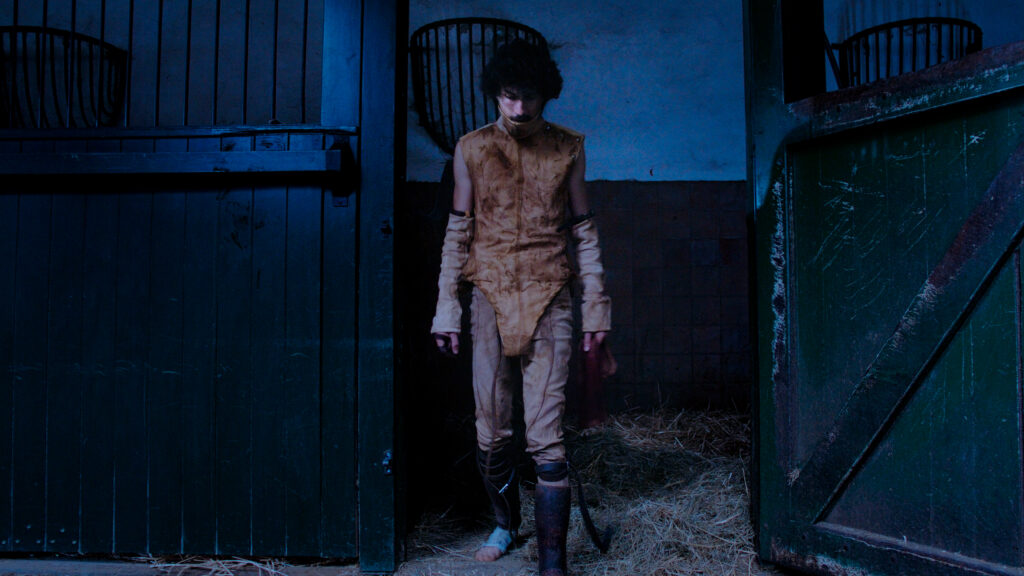
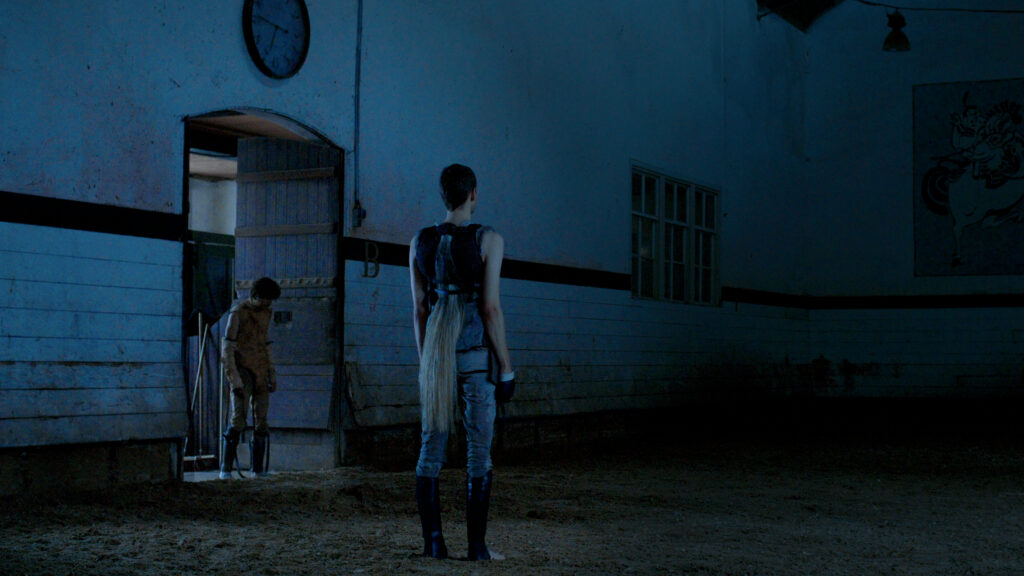
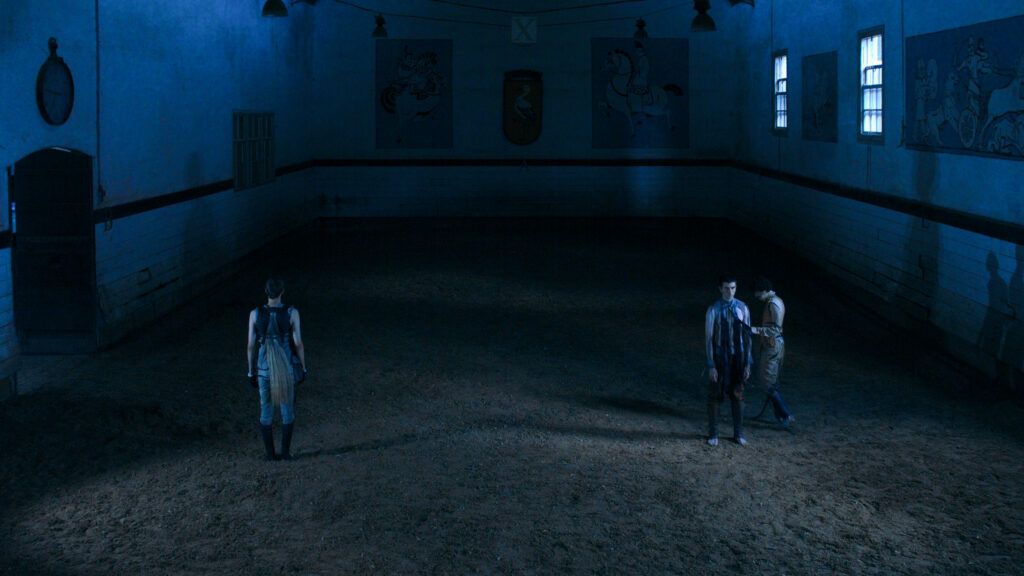
Passing through the stable, he enters the indoor riding arena, where another figure appears wearing a long horsetail attached to the body. The space becomes suspended in an unspoken ritual of mourning.
Outside, the landscape opens into a field with figures standing and lying still. Their bodies nude or dressed in garments made with fragments of their dead horses, hair, hide, or other remnants, suggesting a relationship that persists beyond death.
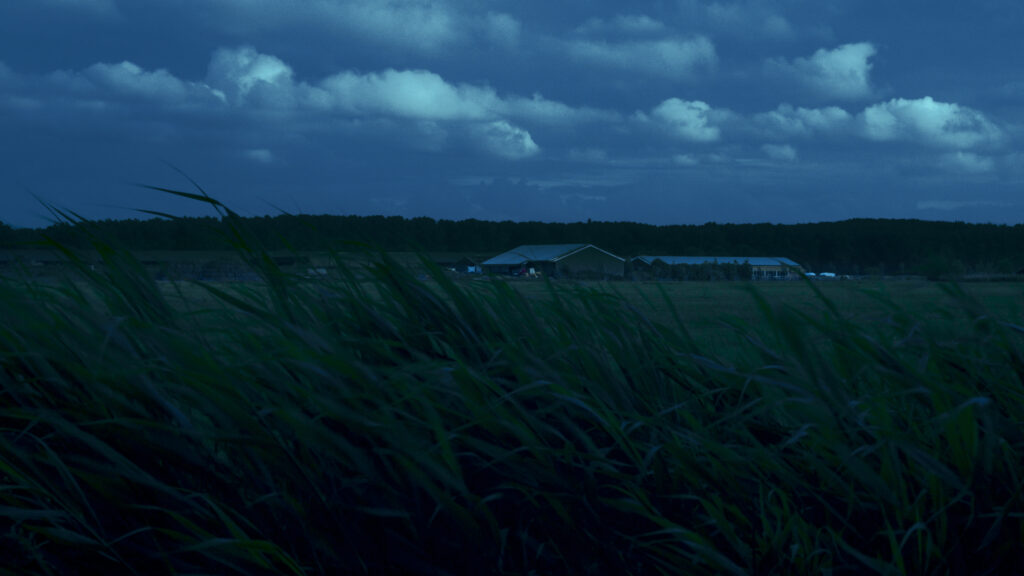
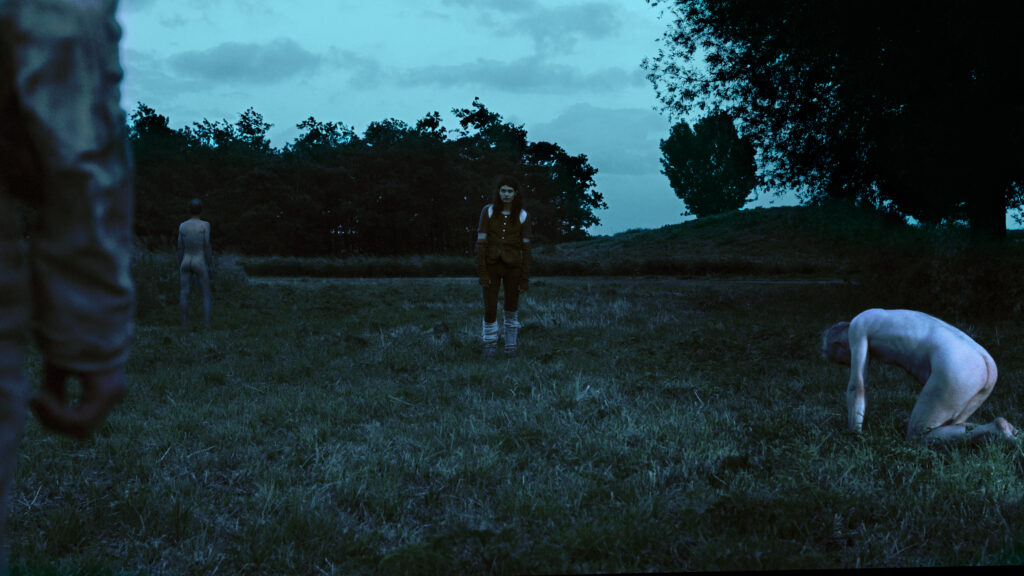
Rather than depicting violence itself, the film explores the aftermath of loss, exploring grief as a physical condition in which the boundaries between human and animal begin to dissolve. The narrative reflects on dependency, embodiment, and the impossibility of separating ourselves from the beings with whom we have shared life.
Director’s Statement
My main interest was sparked by conversation with Anahita about how animals see humans. Rather than having a usual human perspective I wanted to give more power to the animal. Naturally the horse became the hidden protagonist, as all garments were created using fragments of their hair or reins. Absence of the horse was important to amplify the idea of dependency of characters. In the film it us unclear if the dependency is based on love for the animals or the use of them. That way the empty stable becomes a space that carries memory of loss, ritual and consumption.
The garments took the role as extensions of this emotional state. Instead of functioning as just costumes, they became an attempt to preserve a fragile connection to another being. With live worms representing the cycle of life in nature that is equal to every human and animal after death.
Visually, the film embraces stillness and restraint, allowing the light and sound to build the tension. I wanted to give the audience time to reflect on their relation to nature and animals, while challenging a usual context of a fashion film.
Fashion Collection Introduction
Rethinking the relationship between humans and animals is never straightforward; it means facing profound paradoxes that shape how we see and respond to other forms of life. On one hand, acknowledging the fundamental differences the asymmetry between human and nonhuman existence means recognizing the ethical boundaries that quietly guide our perceptions and actions. On the other hand, if we ignore the possibility of meaningful connection across species, we close off the very ground where true ethical engagement might begin. What is at stake here is not only a philosophical distinction, but a deeper confrontation with vulnerability itself: the recognition that both human and animal bodies exist through exposure, through flesh, through a shared condition of being breakable, finite, and dependent. The boundary that separates us begins to feel less stable when we consider that, at the end, we are all bodies matter, weight, skin subject to the same forces of gravity, decay, and time.
Biographies
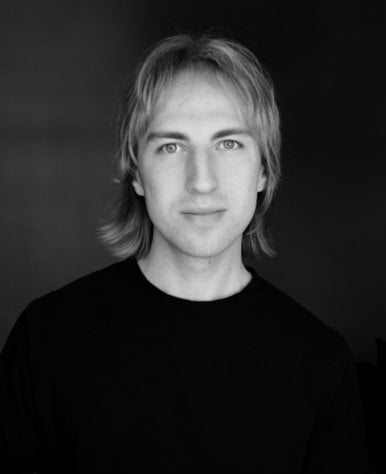
Born 1997 in Kraków, a filmmaker and visual artist based in The Hague. He works across film, video installation, photography and experimental printing, staging directed situations that blur observation and performance. Shown at Galerie Ron Mandos, The New Current (Rotterdam Art Week), Brutus Rotterdam, Het Archief (CAC Łaźnia) and the Hungry Eyes Film Festival.
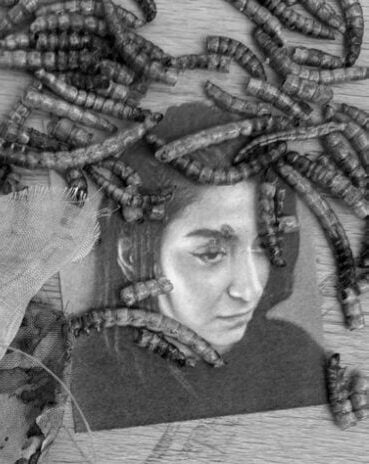
An Iranian multidisciplinary artist based in The Hague and a graduate of the Royal Academy of Art. Moving between fashion, sculpture and installation, she works with organic, reclaimed and animal‑derived materials to probe vulnerability, care and control, and the limits of human dominance. Winner of the Keep an Eye Foundation Fashion Award, 2026.
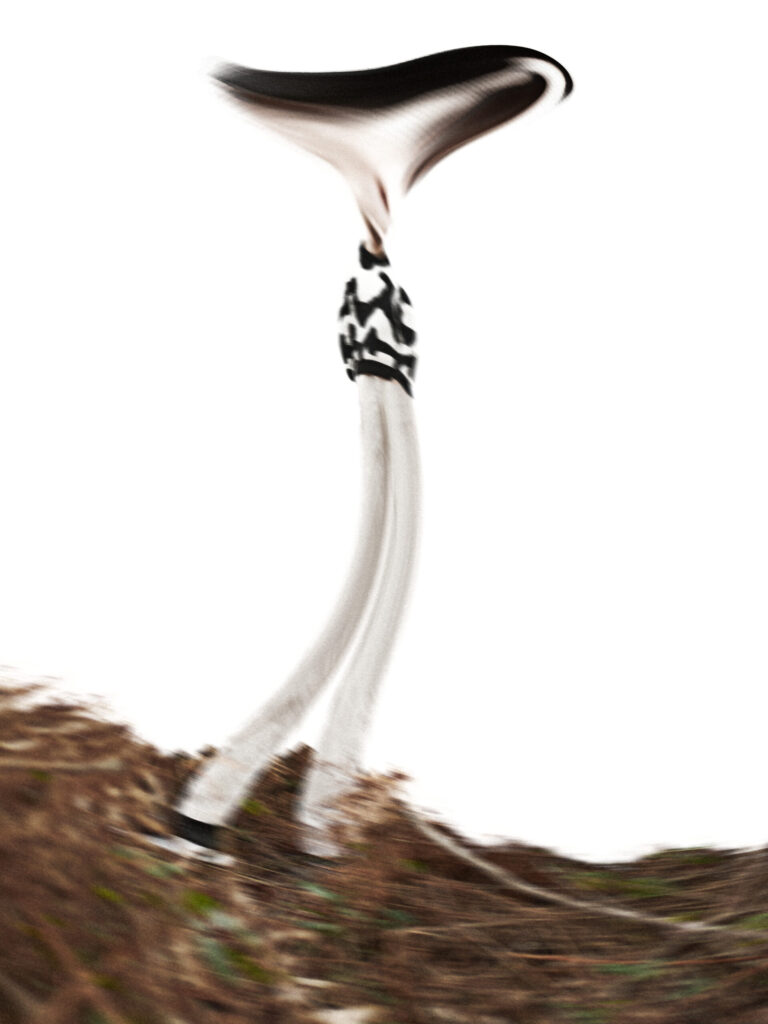
Amsterdam based DJ and producer NAKANO BLU transitioned from drumming to dark electronic music in 2021. His releases blend IDM, bass-heavy diasporic Latin music, techno, and jungle, playing venues like Berghain, Dekmantel, and Tresor. As a sound artist, he collaborates with fashion studios like Maison the Faux and artists across disciplines.
Credits
Director, Camera, Editor: Michał Kucharski @michal_kucharski_
Producer: Anahita Karimi @aknittaa
Cast: Martin Stamboliev, Max Jurek, Anton Kondratov, Fabio Halfenberg, Piet de Rots, Michiel Hers
Music, mixing and mastering: NAKANO BLU @nakanoblu
Graphic design: Alexandr Prikhodko
Location: Manege ‘s-Gravenhaagsche Stadsrijschool
Special thanks: Jungyun Jang
Presspicture for NAKANO BLU: Mauro Testa