L’ABBEYE:
Thanks for making time for this, Tim. I’ve been looking forward to talking through your work since seeing the photos.
You graduated this summer with an MA in Fashion Design from Polimoda. If someone is seeing your work for the first time, how would you put your approach to fashion and your design signature into words?
TIM VAN DER PLAS:
I would say my work is dramatic, honest, romantic and deeply emotional, but rooted in rigorous technicality. I try to illustrate an emotional state to understand it better and open the conversation about inner struggles and the complexity of the human world of experience. As that idea is really quite abstract, I try to keep my designs recognizable as clothing, but always with elements that make you look twice.
The one question I would like anyone to ask is: “What went on in that person’s head to make this?”
L’ABBEYE:
Many designers look outward for inspiration. You chose a deeply personal path instead, digging into feelings of shame and a harsh inner critic. How did you end up deciding to use that inner pain as the foundation for your creative process?
TIM VAN DER PLAS:
I decided to use the struggles with my inner critic as the foundation, because I use my artistic practice to communicate emotions I struggle to express in words. Through the process of making, I feel more understood by myself, while finding the most beautiful insights and reflections about this emotion and I am truly able to process or resolve some of my inner demons.
In the context of this collection, I was able to find a deep sense of self-acceptance, but also through the process of making my BA collection called ‘Secure the shadow, ere the substance fades’, I was able to conceptually and emotionally bury my depression and end that chapter of my life. In a lot of ways, I view my creative process as a therapeutic process, but it is also a great medium to be open, perhaps make others who experience the same feel understood and to break through taboos.
L’ABBEYE:
Your graduation collection is called The Ball of Shame and draws inspiration from Oscar Wilde’s Salomé. Why did this decadent world of extreme obsessions and hidden abysses feel like the most natural fit for your theme, and were there other literary or aesthetic directions you considered and threw out along the way?
TIM VAN DER PLAS:
The story really provided all the angles and sources of inspiration for me, once I started reading it like my inner dialogue, rather than a multi-personal story.
The characters formed the basis of the looks to further develop, the setting of the feast made me wonder what that feast would look like in my fantasy and the illustrations by Aubrey Beardsley laid the foundation for the color palette and some of the silhouettes. The obsession, the drama, the smoke and mirrors and the decadence of the feast are all elements that I like in a good body of work, so I immediately felt inspired by it. A good story makes me picture what I’m reading so vividly that I feel as though I’m living it. I realized that the way I imagined Herod’s feast said much more about me than about the story itself. This thought made me want to dig deeper into myself and into the story. As this train of thought kept going, the mood of the collection and the references I wanted to explore began to take shape It gave me so much space to be creative in, but at the same time I had a guiding thread to hold on to when I would inevitably get lost in references and ideas.
L’ABBEYE:
At a masquerade ball, people use the disguise to show sides of themselves they usually keep hidden. In what way did this setting help you stop concealing your own shame and bring it out into the open?
TIM VAN DER PLAS:
Shame functions in the shadows of your mind. It likes to hide behind insecurities, anxiety and all kinds of other processes that chip away at confidence and self-acceptance.
The idea of a masked ball inspires me to imagine a setting where these workings of shame come to the forefront. That is the point of the collection: to shine a light on what likes to hide, because that is the only way to figure out its true workings. What would a celebration of shame look like? The ball itself isn’t visible, but all the other elements around it were imagined and illustrated in the collection. A lot of inspiration also comes from my experiences in nightlife, where anyone can experiment with their personality and figure out their identity. The invitation I made for The Ball of Shame also illustrates this:
You are cordially invited to witness ‘The Ball of Shame’, to celebrate that which does not wish to
be seen.
A ball in which the covered is uncovered, the hidden comes to light and the dark is asked to
dance.
A night of confrontation, catharsis and transcendence.
With garments dark as confession, where glances reek of sin and music is composed for rooms
without windows.
L’ABBEYE:
You framed the collection as an internal dialogue, with different outfits personifying specific voices of your shame, from self-loathing and paranoia to somatic states. How did you figure out which shape, cut, and silhouette belonged to each of those psychological states?
TIM VAN DER PLAS:
I really tried to imagine who these states would be as a person. “What are they afraid of?” “What do they like?” “What do they hope to find at The Ball of Shame?” “What is their purpose?” All these questions are at the basis of the human experience, but also can create a better understanding of myself when I realize the looks are all parts of my inner workings.
A good example is “Mr. D. Nudé”, inspired by feeling naked or exposed. The look features a long coat with a very high collar and many layers of beautiful black organza towards the hem. No matter how long the coat, how high the collar or how many layers of organza, it remains transparent and quite fragile looking. It explores this state of wanting to cover up, to hide and to maintain this aura of mystery, but the fragility of the character within remains utterly visible. The idea of designing for a masked ball inherently means that there needs to be a very strong definition of elegance in the collection, which is a great challenge for menswear. The first thought might go towards a tuxedo, but there is so much more to discover if you start incorporating historical menswear and womenswear elements, combined with artistic references and experimentation with tailoring.
I think there is a lot of shame that is holding men back from dressing more extravagantly, so I really enjoyed playing around with ambiguity and showing that anything can be elegant.
L’ABBEYE:
Are there any hidden construction details or subtle elements in the outfits that people might overlook at first glance but that felt essential to you in bringing the collection together?
TIM VAN DER PLAS:
One important element that I focused a lot on throughout designing the collection is that I wanted the back to be at least as interesting as the front of the look. This comes forward the most in the wide sculpted pants designed to be worn with the fly at the back and fitted with a preserved rabbit’s foot as the zipper pull and the white leather crinoline that protrudes from the long transparent coat of “Mr. D. Nudé”. It came from this idea that you always have your guard up and feel judged, so an armor against that I wanted the looks to be interesting from every view.
Two details are easy to miss amid the extravagance of Mr. J. Baptiste-sans-Tête’s large black corset: the plate collar and the mask. The collar reinterprets the platter on which John the Baptist’s head is served in Oscar Wilde’s Salomé, as depicted by Aubrey Beardsley. The mask is a self-portrait. Together, they tell the story of a mind struggling with self-acceptance.
Finally, there’s the watchful eye of The Ball of Shame, a silver brooch I made in collaboration with jewelry artist Beer de Haan. It features a glass prosthetic eye encircled by fifteen diamonds. It embodies the authority I’ve given my inner critic and captures its piercing, demanding gaze.
L’ABBEYE:
The setting immediately stands out in the lookbook you created with photographer and set designer Gio Battista. How did that space shape the mood of the shoot, and how does the environment mirror the heaviness and stagnation you wanted to get across?
TIM VAN DER PLAS:
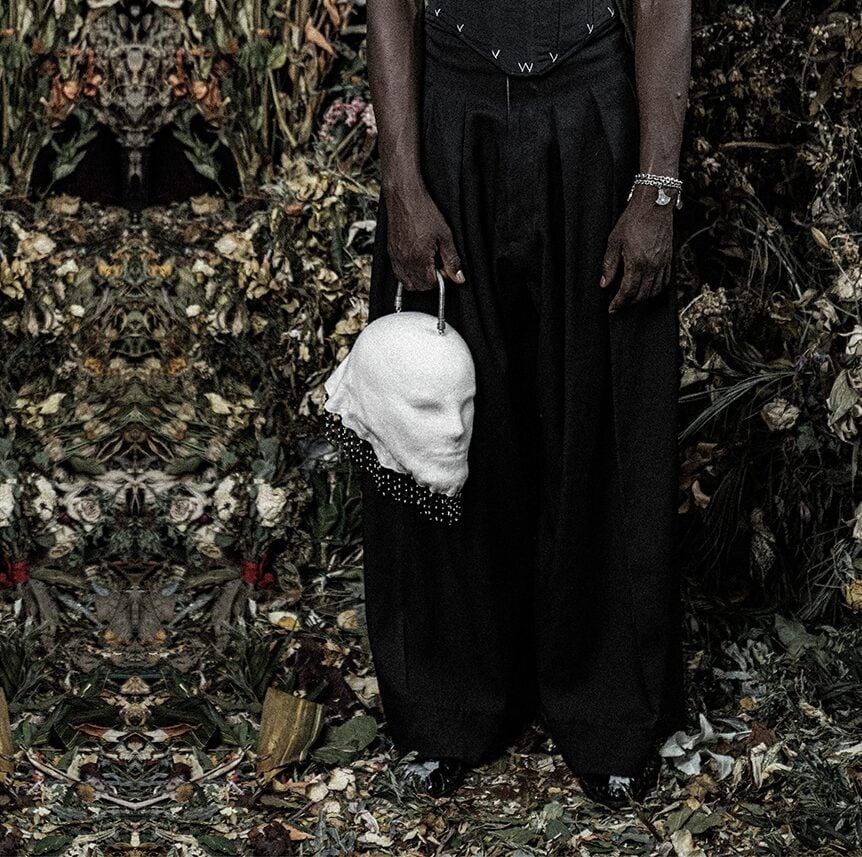
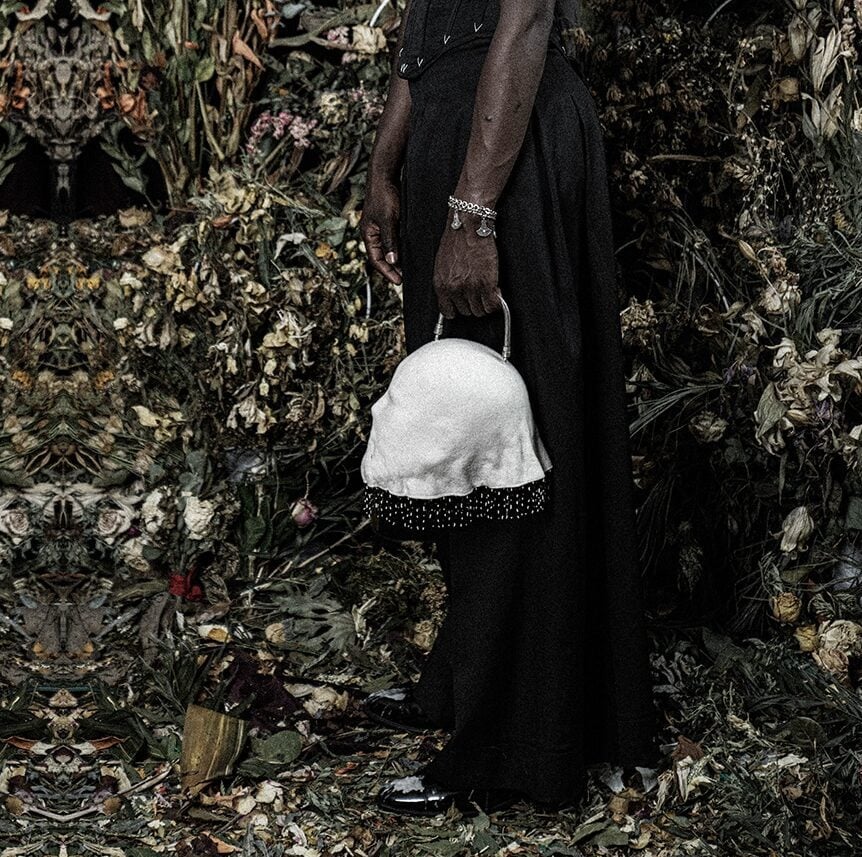
It was shot in Gio’s bedroom, which was filled with thousands of dried flowers that filled the entire room. It perfectly encapsulates this feeling that I imagined the ball would have. The impact of a room full of flowers gives it the drama and decadence I wanted it to have, but when realizing they are all dried and dead, it also gives it this poetic feeling of decay and the emotional weight of the inner struggle that the collection portrays. The sheer number of flowers and the landscape framing helped convey the scale I wanted for the collection.
L’ABBEYE:
In the lookbook, the models wear masks, and the sculptural bag mirrors facial features. What role do these elements play in the collection?
TIM VAN DER PLAS:
The masks are an interpretation of a series of self-portraits, where I tried to illustrate how social anxiety influences my self-image. So the masks and by definition this collection in essence are an abstract self-portrait.
The use of faces throughout the collection, like in the white “headbag”, the printed morning coat and the masks, is a reference to the judgment felt in social anxiety. This judgement comes from inside, but is presented to you as being an opinion formulated by others. That’s the difficult aspect of shame and social anxiety for me. By playing with what’s my inner dialogue and what is outside me, I got to know my inner critic a lot better and then I could distinguish between the two better.
L’ABBEYE:
Working on a project with such a personal core brings its own difficulties. What practical or conceptual challenges did you run into, and how did you know that your design choices were actually capturing the feeling you were after?
TIM VAN DER PLAS:
It is very easy to get lost in the process.
In essence you’re trying to formulate a whole world of experience in just a few looks, so it is important to use the concept of the collection as the deciding factor for every decision you make. The concept is there to make decisions easier and keep the story clear. If a design, experiment or reference brings me closer to what I imagine when I think of a bal masqué for shame, then that is the right decision. However, that is quite a strict framework to think from and it can sometimes lead me to not be playful and go out of the box a bit more.
I tend to work more as a scientist than a child with a box of freshly-opened crayons, so I tried to use processes that make me do before I can think so the playful side has to come out. For example, I sketched a lot with charcoal: no erasing and the page can be full with just a few strokes. Most of them didn’t take longer than 30 seconds. This way I could channel the emotion without overanalyzing it.
If you make before you think, the work is often very close to what’s happening inside. There is a lot of thinking to be done from the initial sketch until a garment is finished so finding out what the feeling is and staying true to that is the most difficult part.
L’ABBEYE:
Now that your studies are finished and the collection is out in the world, how are you looking at your future in the fashion industry? Are you planning to take this kind of radical honesty with you into whatever comes next?
TIM VAN DER PLAS:
I’m looking forward to developing as a designer and as an artist. I’m always hungry to learn as much as I can, whether that’s in technical skills, being able to make someone feel powerful or sexy, or to further refine my method of illustrating an inner world of experience.
I think radical honesty in fashion, but even more so to the world around us is essential at the moment. Fashion is always a reflection of the zeitgeist and it is clear that our current world is based on a lot of hot air. I hope to inspire honesty, empathy and poetry, without it being entertainment. When those things are met with thoughtful design, I can see a lot of beautiful things being made in the future.
L’ABBEYE:
When people experience your collection, what is the core feeling or unspoken message you want to stay with them?
TIM VAN DER PLAS:
To quote Alexander McQueen, one of my biggest inspirations: “I don’t want you to walk out feeling like you’ve just had Sunday lunch. I want you to be repulsed or exhilarated – as long as it’s an emotion.”
Credits
Designer: Tim van der Plas @timtimclub
Photographer and Set Designer: Gio Battista @deadmeatx_x
Jewelry: In collaboration with Beer de Haan @beerdehaan
Interview by Maxim Quiring @enfantpauvrehereux