

Can luxury ever be counterculture, or does the phrase collapse under its own contradiction? Pierre Bourdieu thought the question answered itself: haute couture is haute culture, by definition, and high fashion does not critique the social order so much as embody it, season after season, in cloth. The suspicion worth testing is whether avant-garde fashion escapes that verdict, or only dresses it up, wearing the costume of rebellion while performing, once again, a service to the people who already run things.
For Bourdieu, haute couture incarnates symbolic and social capital in economic form: it marks, with unnerving precision, exactly where a person sits in social space. In Le couturier et sa griffe (1975), “The couturier and his signature,” he described a semi-autonomous field organized by binary oppositions, dominant against dominated, rich against poor, in which a house’s position simply repeats, in miniature, the position its clients already hold outside it. Within that field the couturier manufactures capital out of nothing at all. A signature does the work a stamp does for currency: it assigns value to cloth the way a mint assigns value to metal, the same alchemical trick Duchamp performed by signing a urinal and naming it Fountain. Call it magic, if magic means turning refuse into gold and asking no one to notice the substitution.
There is something coldly cynical buried in this account. Fashion, for Bourdieu, exists to let the aristocracy manufacture its own distinction; the couturier is less an artist than a conjurer, dressing domination up as nature. But a diagram that maps a hierarchy can just as easily map whatever refuses to sit inside it, and avant-garde fashion has always answered to that second possibility, functioning as art before it ever functions as clothing. Enfants Riches Déprimés takes the couturier’s cynicism and hands it back to the audience, unchanged but exposed, until the exposure itself becomes the signature.
The name alone stakes a claim beyond the merely social. Enfants Riches Déprimés, Depressed Rich Kids, names its audience with an irony sharp enough to cut both ways, claiming ambition and mocking it in a single breath. The Spring/Summer 2026 show staged that ambivalence inside the Hôtel de Maisons, models crossing gilded rooms while, outside, a child sat alone on a blackened swing beside a bronze skeleton and a crystalline crypt.
The clothes make the same point plainly. A navy jacket piped in red and buttoned stiff to the throat borrows from parade dress, the antique buttons standing in for a family crest, the fabric held rigid enough to look worn rather than chosen. A black leather jacket, oversized and glossy, cut like a chauffeur’s and finished with a peaked cap, dresses wealth down into service. A bomber worn open over a loosened tie and ribbed leg warmers reads as a uniform gone slack, half detention and half parade. A coat split down the middle between stiff wool and a train of unlined lace leaves the body looking armored on one side and undressed on the other, the two fabrics refusing to agree on what they’re protecting. Each look does what Bourdieu described: capital dressed up as legitimacy, wealth borrowing the appearance of a history it doesn’t actually have.


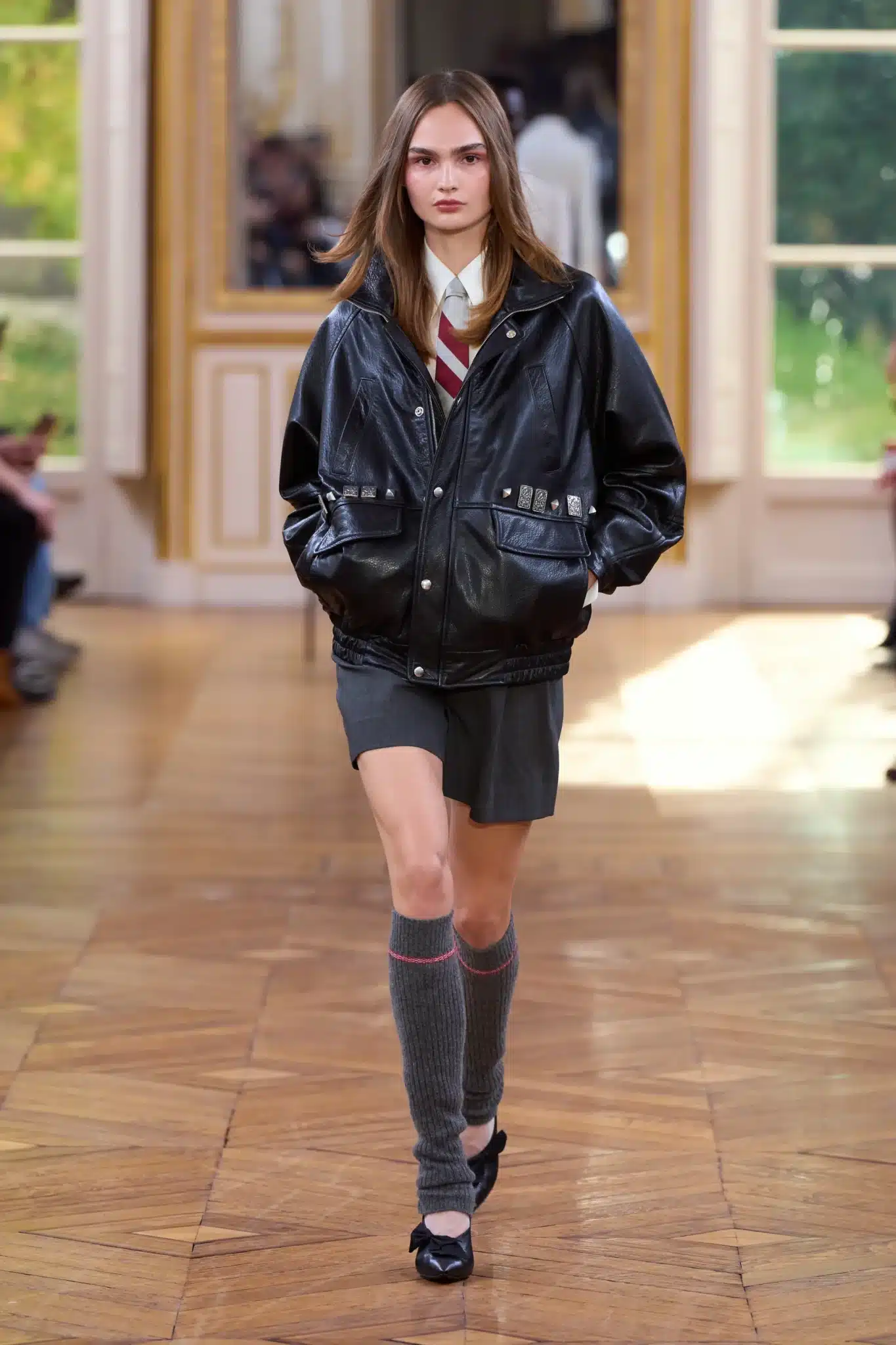


The house treats obsolescence itself as a house style. Runway films are shot on camcorder rather than professional video, grain and light leaks left uncorrected, so that a show streamed live already resembles a memory of itself. For Fall/Winter 2016 the label went further, collaborating with the estate of Cy Twombly on a capsule built from the artist’s own Polaroids, someone else’s private archive stitched directly onto the clothes. Every season repeats the trick: whatever the audience is looking at reads as already old, already lost, gone before it has finished happening.
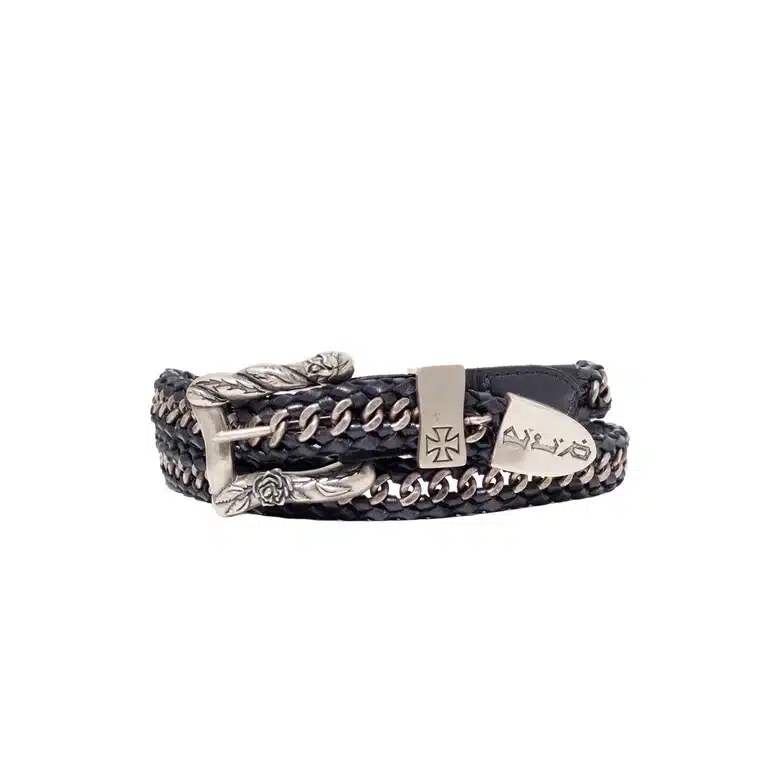
The brand appears to mock high culture by draping it in decadence, and its postwar European borrowings push that further, gesturing at the elites who made their peace with fascist authority and then spent decades pretending they hadn’t. The Iron Cross, a Prussian decoration the Nazi regime later stamped with its own emblem, functions here as exactly that gesture, the grandfather’s ghost dragged out of a closet good families keep carefully locked. Henri Alexander Levy built the house in Los Angeles in 2012 on precisely this habit, reifying the symbols of subculture and history across garment, performance, and exhibition alike, from a first runway presentation at Christie’s Paris to collaborations with Richard Hell, Larry Clark, and Daft Punk. The house describes itself as anti, neo, and post: anti-establishment in what it says, neo in the sense that it recycles and updates old codes rather than inventing new ones, post in the sense that it assumes both the avant-garde and the counterculture it borrows from are already finished.
Even the accessories carry the argument: black leather braided with aged silver chain closes around a buckle stamped with an Iron Cross, small enough to overlook and large enough, once noticed, to mean exactly what it says.
The same logic governs the house’s choice of brand ambassador. Casting Marilyn Manson to open Fall/Winter 2026 reads, on the brand’s own terms, as a rebuttal of the elitism Bourdieu described, the target shifting from wealthy aristocrat to punk outsider. But Bourdieu’s own logic complicates the gesture rather than answering it: this is not an escape from the field he described so much as a further move within it, punk reclaimed as one more form of capital, borrowed and worn back into the room where money still decides what any of it is worth.

The set announces its true subject before a single look reaches the audience. Models walk a path cut through a garden buried in snow, past clipped topiary and stone urns arranged with the gravity of a private estate rather than a stage set, toward a bronze statue group planted at its center: a heavily decorated
military official struck through the back as though felled by his own side, and kneeling at his feet, a pale, chained female figure, still devoted to the man collapsing above her. Not a monument to power, in other words, but to power already failing, caught mid-betrayal by the very hierarchy it once commanded.
Read on its own terms, the ambition here is serious, and irony is the method rather than a decoration on top of it. The house names its own audience’s wealth and self-satisfaction in its own title, then repeats the trick on the runway: a toppled officer instead of a triumphant one, a chained woman instead of a crowned one, nothing resolved into comfort. That irony does real work. It drags subjects elites would rather leave alone, their own complicity with fascism, the unfinished business of feminism, punk’s absorption into the market they once opposed, back into a room built for people who could otherwise ignore all three. Enfants Riches Déprimés positions itself as a critique of exactly the amnesia Bourdieu’s framework leaves unexamined: how easily European elites filed their own fascist complicity away as a manageable historical footnote, and how quickly punk’s promise of liberation was repackaged and sold back to the children of the people it once opposed. None of that ambition is naive on its face.
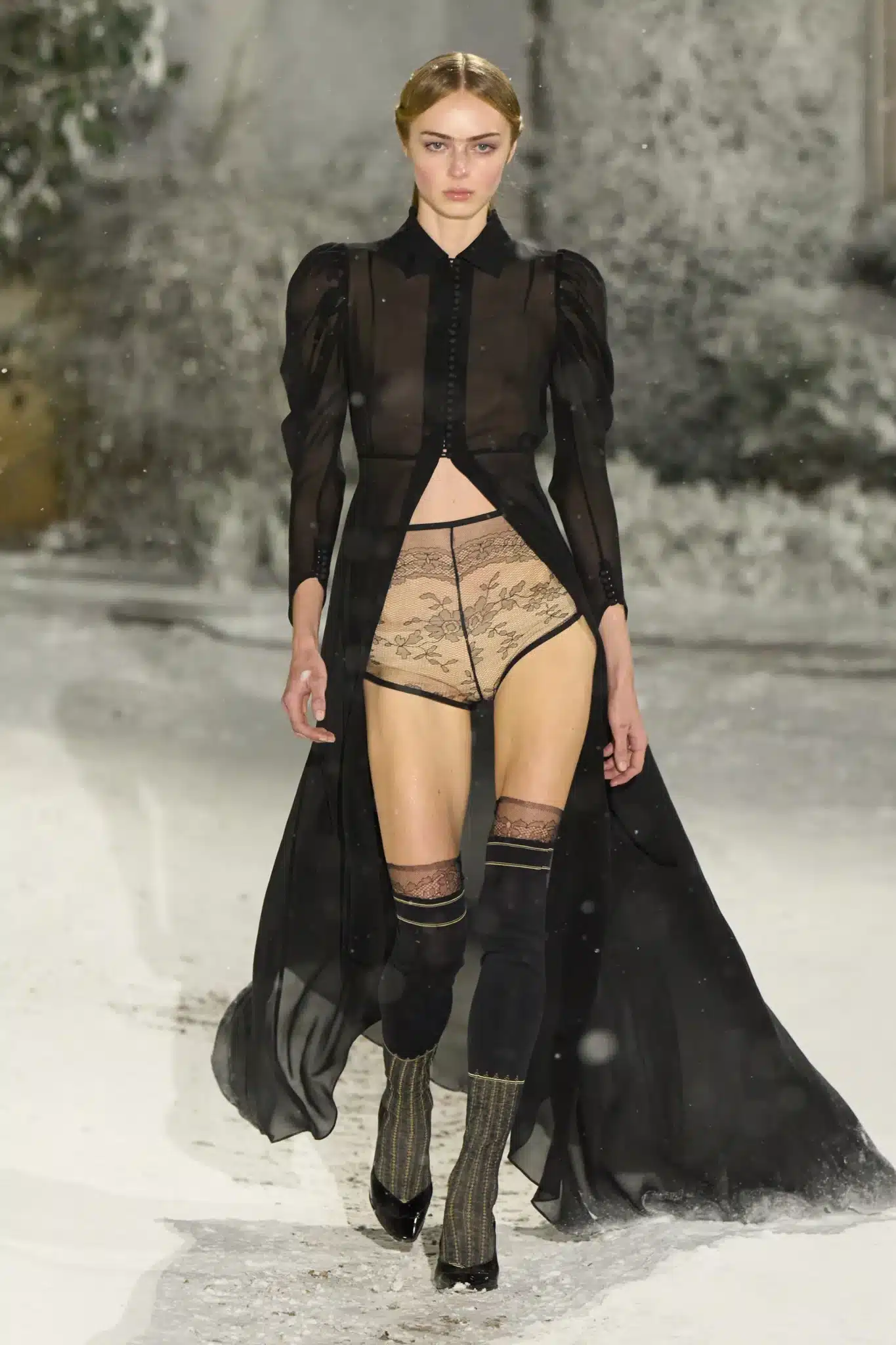
The clothes carry out what the statue stages behind them. A black leather greatcoat, heavy and slick, cinched with a chain, closes the body into pure uniform, the order the show’s own note says will be immediately understood. A grey coat trimmed thick in fur plays the same rank as warmth instead of threat, softer to look at but built on the same idea. Further down the path, an olive utility jacket patched and worn at the elbows reads as that same uniform gone to seed, cloth standing in for years rather than rank. Against all of it, one look refuses to close at all: a sheer black blouse open to the waist, nothing buttoned, the fabric thin enough to show through rather than cover. Structure, decay, and exposure make the same argument three times over: power holds itself together until, eventually, it doesn’t.


The brand’s own account of itself runs into a problem it can’t talk its way around. Borrowing a symbol assumes the borrower still controls what it means once it’s out in public; it has nothing to say about what happens once that stops being true. Marilyn Manson faces sexual assault and abuse allegations from more than a dozen women, including his former partner Evan Rachel Wood, a case a California judge reopened only weeks before he walked the show, and the house’s Iron Cross pieces sit inside a wider pattern: a swastika printed on a T-shirt sold as anti-fascist, references to the Nazi salute, a 2026 release widely condemned as the brand’s most openly racist yet. The amnesia the collection claims to expose in European elites starts to look, from here, less like exposure than repetition, the grandfather’s uniform taken out of the closet not to be examined but worn again, at a considerable markup, by people who were never asked to answer for it the first time. A house charging several thousand dollars for a coat is not selling rebellion to anyone who would pay for it with something real. It is selling the costume of paying, priced the way luxury prices everything else, by how few people can afford to wear it.
A sharper objection waits beneath all of this, one the philosopher Jacques Rancière raised directly against Bourdieu: critical sociology quietly keeps for the sociologist the very freedom it denies everyone else, seeing through taste as domination while the people it studies stay trapped inside the illusion. Exposing elite complacency risks becoming, in the same gesture, a new kind of elite position. That charge reaches any piece of writing, this one included, that claims to see through a fashion house’s irony more clearly than the house sees through itself.
Fashion, on this account, is never simply unconscious of its own domination, whatever Bourdieu assumed. Enfants Riches Déprimés proves that a house can register its own complicity and use it anyway, turning the couturier’s oldest trick into the actual subject of the work rather than leaving it as a blind spot. That doesn’t make the house innocent of what it has done. It does mean the irony is not just decoration: it is the one place where this label manages to say something Bourdieu’s model never left room for.
Credits
Written by QBL
Cover: @eth0s_shanghai