

Like any art form, fashion leaves its mark on history, but unlike others, it leaves behind objects that have touched bodies, moved through spaces, and absorbed gestures. They capture a specific moment, frozen in time, that created history people will still be talking about years later. But after the death of their creators or the person who contributed to their popularity, these pieces become… archives.
Often displayed so that the public can recall or even discover some part of history, an archive is not just about preservation; it is an interruption. A garment stops moving and evolving when it becomes an archival object. It is like a plant pressed between the pages of a book: perfectly preserved in form, but forever stripped of growth, season, and life. Isn’t it
the same for an archive? This raises a meaningful question: Isn’t a garment meant to be worn?
The very purpose of a garment’s existence is to undergo changes, to deteriorate, and to tell a story through its life. Without this specific characterization, they become something else: an artifact or a relic, a mere reflection of themselves. Something frozen, fixed in space and time. And this is why some designers refuse this permanent fixation, to ensure one important thing: a story through life.
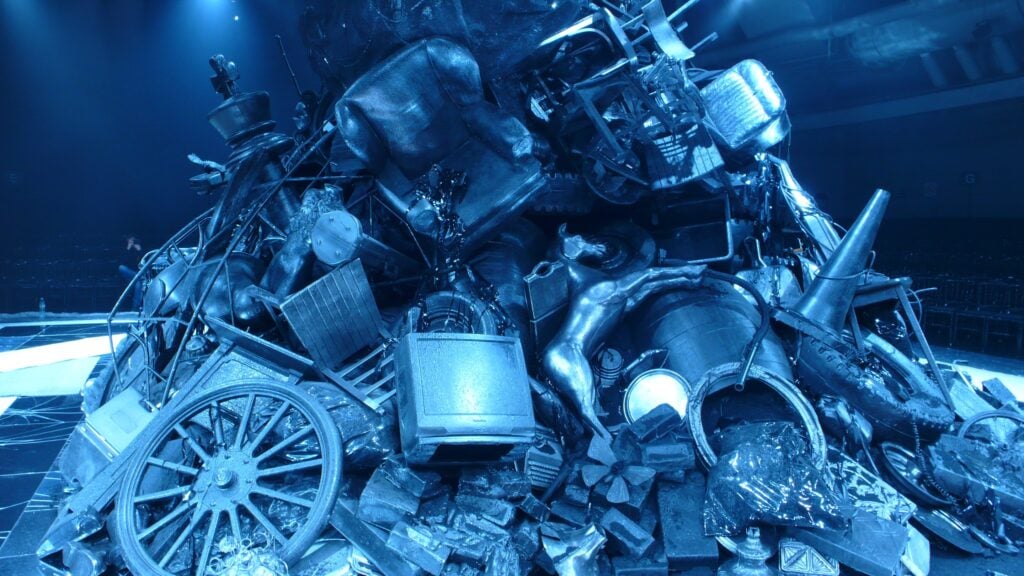
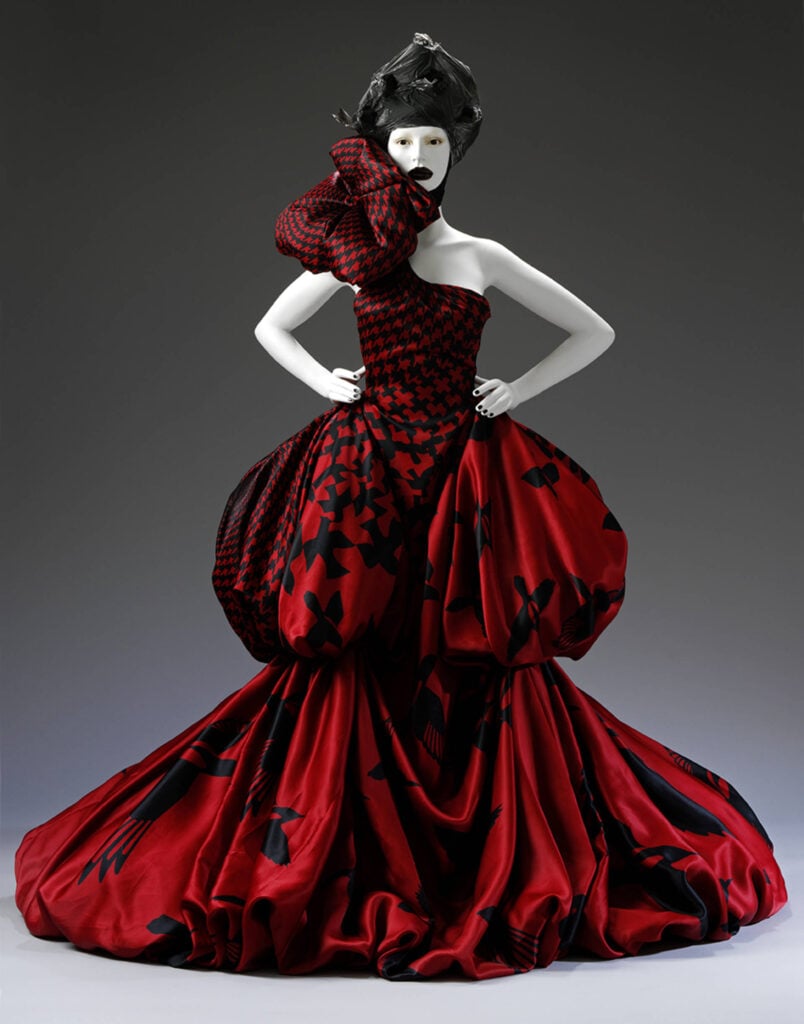
For instance, Lee Alexander McQueen always criticized how polluting and repetitive the fashion industry had become and set out to explore the artistic reuse of garments as a form of protest. His Autumn/Winter 2009 collection, The Horn of Plenty: Everything But The Kitchen Sink, was staged as his own retrospective–fifteen years of work, eaten and thrown back at the audience. The runway itself was littered with accessories recycled from his earlier shows, and a mountain of “rubbish” built from past pieces sat at its center, spray-painted black. McQueen reused his own house codes, like the blackbird print from The Birds (Spring/Summer 1995), reworked here as a magpie on a cherry-red taffeta dress. A private archive, resurrected and recycled rather than framed. But he also turned his satire outward: opening with a parody of Dior’s New Look before moving through other couturiers’ signature silhouettes, mocking an industry he felt had run out of ideas and could only cite itself. In other words, McQueen didn’t just refuse to let his own archive die: he challenged the whole fashion industry. Some garments were literally constructed from earlier pieces, giving them a new soul and avoiding the fixity of preservation. McQueen saw the archive as something alive which needs to live to fulfill its own purpose.

But Lee Alexander McQueen is not the only one with this vision. Martin Margiela and Rei Kawakubo, Belgian and Japanese designers, chose not to preserve garments as archives either. Instead, they embraced or simply ignored their existence, each pushing the idea further than the last.
Margiela treated the archive as raw material rather than heritage. In 1994, he launched “Replica,” a line built entirely from vintage garments, sourced from flea markets and thrift shops across the world, that he reproduced identically and sold under his own label. Each piece carried a plain white tag disclosing its origin, so its primary story could still be interpreted and readable. Margiela wasn’t preserving these clothes like common archives; he was cloning them, distorting them, and letting them have a second life in an authentic way, linking their past memory with their current use. The archive, in his work, is not sacred. It is something material that can be handled, resized, and altered.
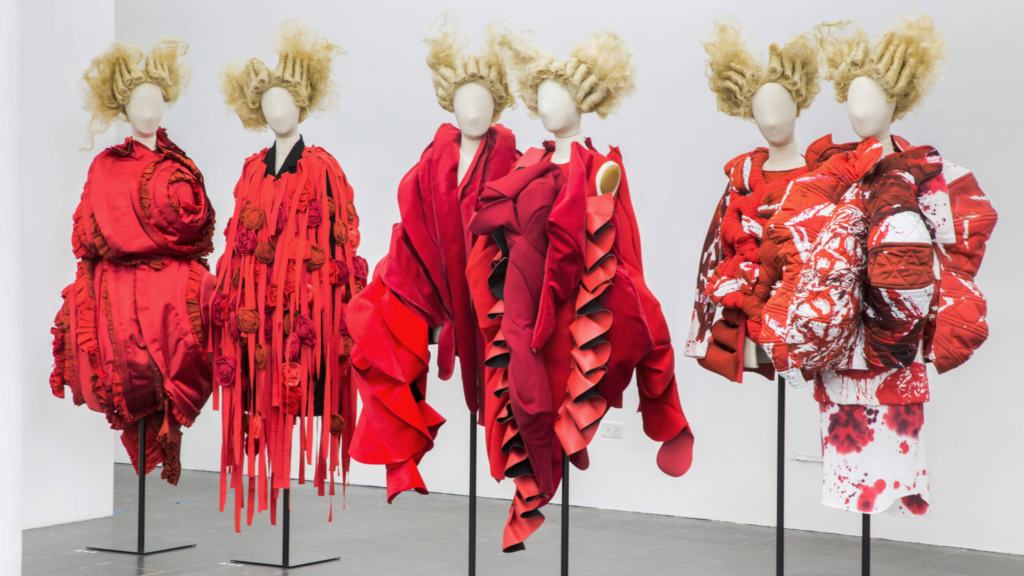
From a different perspective, Kawakubo goes much further still: she doesn’t like archives and treats possessions, including her own past collections, as a burden. For a long time, she refused the idea of a retrospective of her Comme des Garçons work, as she truly believed it only exists in the present, with each collection having its own time. When Kawakubo finally accepted the Met’s Costume Institute tribute in 2017 (Rei Kawakubo/Comme des Garçons: Art of the In-Between), she decided not to go with a traditional chronological exhibition with her best work at the center. Instead, she organized it around themes and conceptual tensions like Absence/Presence and Self/Other. There was no cult of the object, no vitrine worship of the archive. Just an artistic structure of human philosophy. Kawakubo, in a way, lives in a refusal of having a garment of the past be fixed or
repeated in the present. A thought that brings up a question related to the concept of human attachment: Does the past really need to be part of our present?
So, while for McQueen and Margiela an archive can be manipulated and reconstructed, for Kawakubo it’s a symbol of rupture. However, these three positions make one thing clear: an archive is never neutral. Preserving a garment is to remove it from risk, but it’s also immobilizing it. The so-called sacred status of archival pieces does not always elevate them, it transforms them into objects that can no longer fail, but can no longer live either. Something in the middle, like purgatory.
But in theological narrative, purgatory is not a place to stay. And this is exactly when and where the comfortable idea that the archive should simply remain suspended, unresolved, both In and Out, starts to fall apart.
McQueen, Margiela and Kawakubo don’t just illustrate three attitudes toward the archive, they demonstrate, each in their own register, that survival requires re-entry into use, risk, or disappearance. McQueen fed his own history back into the machine and let it be reborn as a satire. Margiela let the archive circulate again, cheapened, resized, stripped of its aura, and somehow more honest for it. Kawakubo refused the archive almost entirely to avoid looking back, which is -for her- a death sentence for her work.
So the answer is not to let the archive hover indefinitely between states, protected from judgment by its own ambiguity. The answer is that the archive must live, and if it means being worn again, so let it be. What we should stop doing is dressing up preservation as a form of respect. It isn’t. A garment was made to be worn. Anything else is a eulogy we haven’t had the honesty to write yet.
Credits
Written by @shinigabry