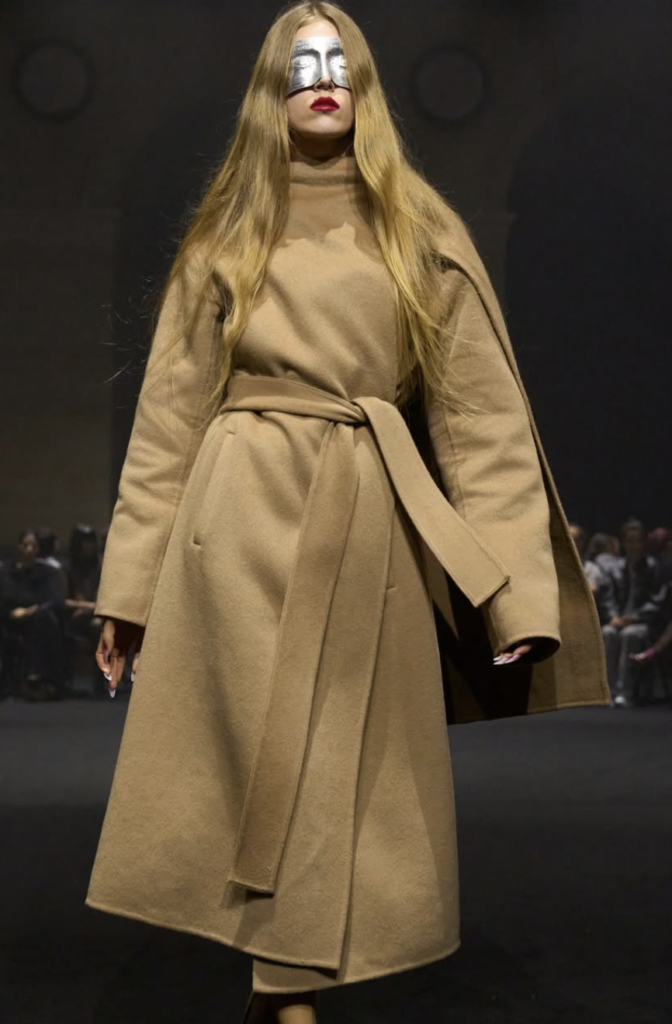
Fashion claims openness, but generally operates on calibration. Break the rules? Yes. Just not enough to disrupt the system that defines them. Difference is tolerated as long as it remains legible. Beyond that, it might cause a stir. And yet, it is precisely there, at the edge of discomfort, that fashion becomes necessary. Embracing the offbeat, the quirky, and marginality is not only a stylistic choice but also a position. Alexander McQueen understood this, just as Matières Fécales insists on it today.
While fashion can be perceived as a language, strangeness is one of its dialects, one of those which do not ask to be understood, but impose themselves. Both McQueen and Matières Fécales view strangeness not as something ugly or unaesthetic, but rather as a declaration of rejection of the “traditional beauty” everyone agrees on. Here, fashion, clothing, aesthetics, and nonconformity are used as tools for storytelling, or even for denouncing our society and the elements surrounding it. Lee Alexander McQueen was not just decorating the silhouette, he destabilized it. The grotesque, in his work, is engineered. Volumes swell where they should not, waists compress to the point of constraint, and shoulders erupt into sculptural excess that screams one thing: “too much.” The body is pushed into imbalance, sometimes into something almost uninhabitable. In The Horn of Plenty: Everything But the Kitchen Sink (AW09), the figures are no longer fully human, they are inflated, masked, and dislocated.
Behind the creepy and disembodied-looking red smiles lie several genuine critiques of the industry. The references to Dior, Poiret, Chanel, and Givenchy in the shapes or patterns of the looks are not nostalgic, they are parasitic, exposing an industry suffering from a lack of innovation. Garbage becomes garment, excess becomes a silhouette, critiques of environmental issues and overconsumption. The grotesque here is not an aesthetic experimentation, but an accusation. And obviously, the body is carrying the weight of overproduction mixed with the creative exhaustion of a system collapsing under its own abundance.
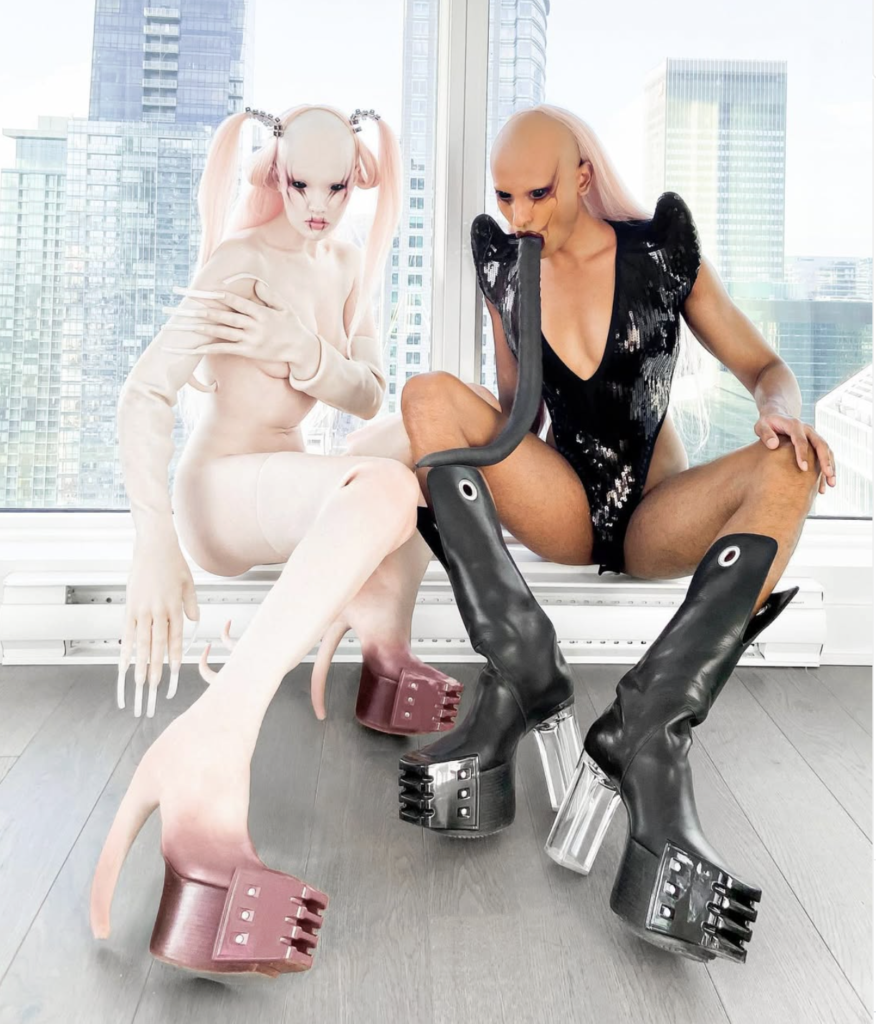
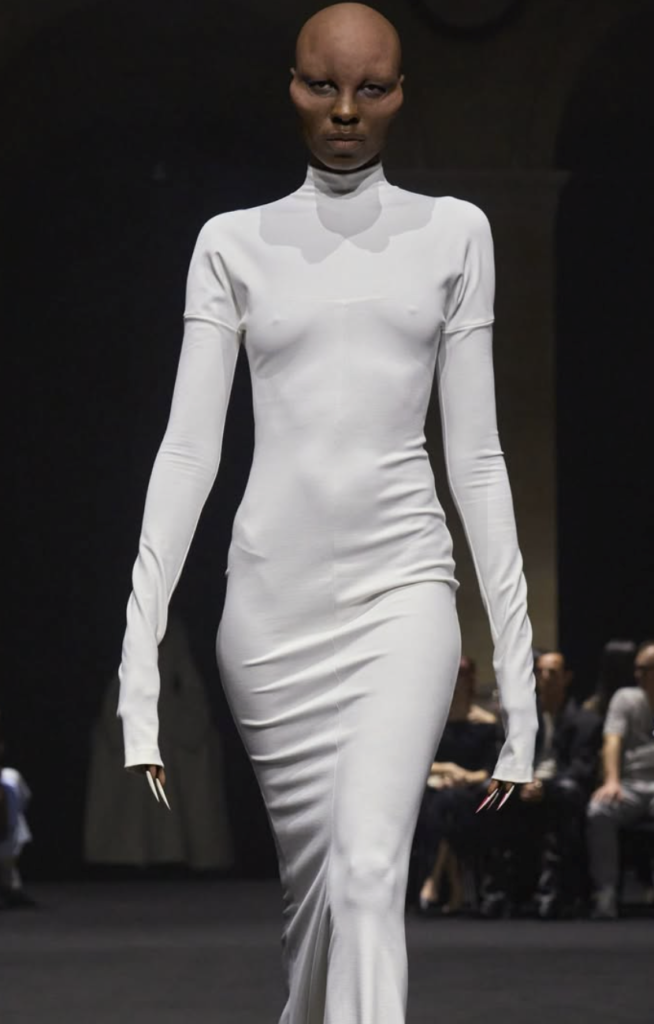
A few years later, Matières Fécales is picking up, in its own way, the torch left by the late Lee Alexander McQueen. Born out of the shared frustration of Hannah Rose Dalton and Steven Raj Bhaskaran with the fashion industry’s textile waste problem, they express their weirdness differently. Matières Fécales don’t distort the body. They abandon it. Their work does not operate within human proportions, nor does it attempt to. Instead, it proposes something entirely new: a post-human surface where identity dissolves. An aesthetic not built on transformation, but on erasure, where skin is replaced by synthetic finishes, faces become unreadable, and silhouettes detach from anatomy, like the two designers who embody a trans-human identity through their own physical appearances. Everything has been said with the name chosen for the brand: Matières Fécales. Fecal Matter in English. It’s a refusal, a rejection of global standards.
And just like McQueen’s spirit, Matières Fécales speaks out, a continuity we could say is best embodied by Lady Gaga, who wore McQueen’s iconic Armadillo shoes from SS10 Plato’s Atlantis, and more recently, Matières Fécales’ widely controversial curved heels. In their collection The One Percent (FW 26/27), the garments function as direct statements. Eyes covered with banknotes highlight our vision being obstructed by capitalism. We, as spectators, can see denunciation of power structures, like the concentration of wealth, the objectification of bodies, the culture of secrecy, or even the protection of elites. Gag balls incorporated in different looks could evoke submission and the inability to speak or speak out; the distorted faces might be a reference to the erasure of identity; while the silhouettes, reminiscent of cult imagery, depending on the point of view, could evoke relationships of control in which power is exercised through submission and depersonalization. The parallel, therefore, does not lie in the factual elements themselves, but in their symbolic structure: when economic power becomes absolute enough to transform human beings into objects of exchange, pleasure, or prestige, capitalism ceases to be a mere economic system and becomes a system of domination.
In a way, this is not futurism. This is exposure. The post-human here is already present, produced by systems of wealth, image, and control. Beauty is no longer distorted; it is revealed as distortion. So, what if the true face of beauty is disgusting?
What McQueen and Matières Fécales share, beyond aesthetics, is a refusal to let the body remain silent, and in doing so, they hold up a mirror to something much larger than fashion. Ultimately, this is a striking reflection of our society. What is seen as weird or standing out is not ugly or abnormal. Rather, it is simply something the majority does not want to see, because it is easier to look away than to accept differences. Yet embracing your quirky, offbeat, and unique side may be truer than the reality surrounding us.
McQueen and Matières Fécales operate differently but arrive at the same point: the body is not neutral, and fashion is not innocent. Being “weird” is not just about being eccentric, it is to refuse standards and categorizations. And still, the system absorbs everything. The grotesque becomes editorial. Alien aesthetics become a trend. What resists is quickly renamed and reframed, while difference becomes content.
In the end, in a world that teaches us how to dress before we even learn how to see ourselves, what does it mean to refuse standardization? Alexander McQueen carved beauty out of discomfort, while Matières Fécales goes even further with an unassimilable aesthetic. Fashion is not only self-expression but also a disruptive way to communicate. And yet, even the grotesque becomes aesthetic. Even a critique becomes a look. The system has an appetite for the unfamiliar, and what begins as a quirky, misunderstood creation ends as a reference. If the radical offbeat can be curated into a moodboard, then perhaps authenticity is subjective and fluid over time. Refusing standardization is not a fixed state or a trend to be captured, but a constant effort to keep the body unavailable to the system.
Credits
Written by @shinigabry