Published on July 29, 2026

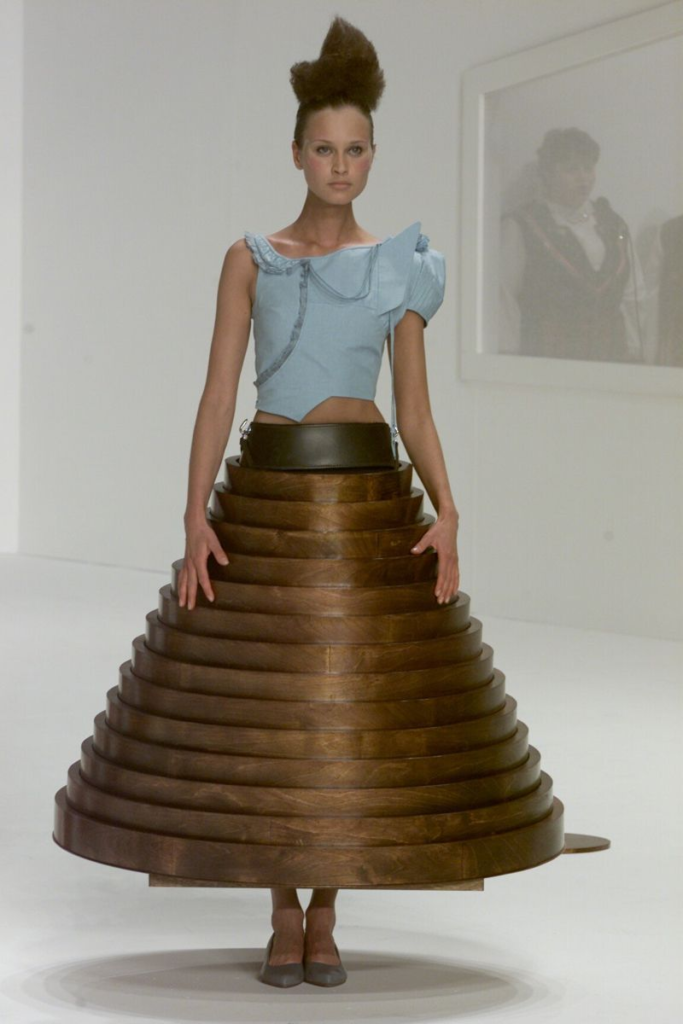
One aesthetic mourns the past. The other imagines the future. Between neo-gothic and neo-futurism, contemporary fashion continues to seek meaning anywhere but in the present.

Escapism is not a secret anymore. It’s a dress code.

Fashion answers social collapse the way it always has, by refusing the present tense. It looks for meaning in what has already collapsed, and in what hasn’t been built yet, anywhere but here, anywhere but now.

Few aesthetics refuse to die twice the way these two do. Neo-gothic and neo-futurism keep resurfacing across the runways like two faces of the same coin, two liturgies written for the same crisis of faith in the present moment. One speaks the language of the heart, a romanesque nostalgia mourning what was. The other pierces the soul with an ultra-modern garden of Eden, a future promised, never arrived.

This is the story of both. How decay became a form of beauty. How utopia became a fabric.

NEO-GOTHIC: DECAY AND ROMANCE

To wear neo-gothic is to feel watched. Not by an audience, by something older, something that doesn’t blink. Stand beneath a vaulted ceiling built centuries before you were born and you understand it instantly, without needing to be told: you are being measured against something eternal. That’s the first thing neo-gothic does to a body. It makes it small in front of the divine, then dresses that smallness in couture.

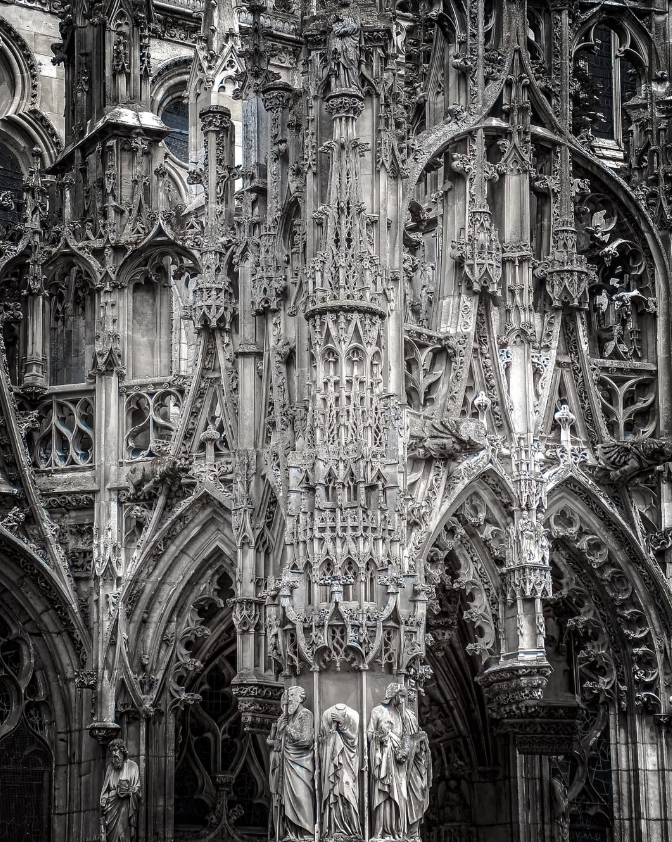
The aesthetic borrows its bones from Gothic Revival architecture, the 19th-century movement that resurrected medieval cathedrals in an age of industry, all pointed arches and soaring verticals, engineered not for comfort but for awe. Fashion didn’t inherit the architecture. It inherited the feeling, that particular weight of being scrutinized by the eyes of the divine, translated from stone into silhouette.

Church of Notre-Dame de Louviers, France by @gothicarchitecture

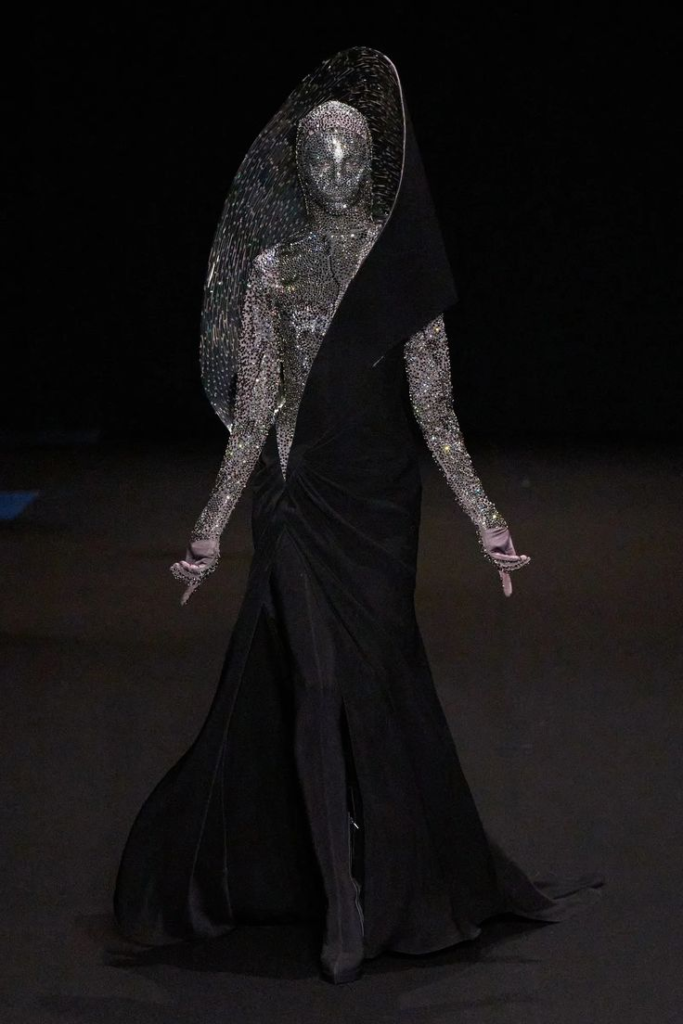
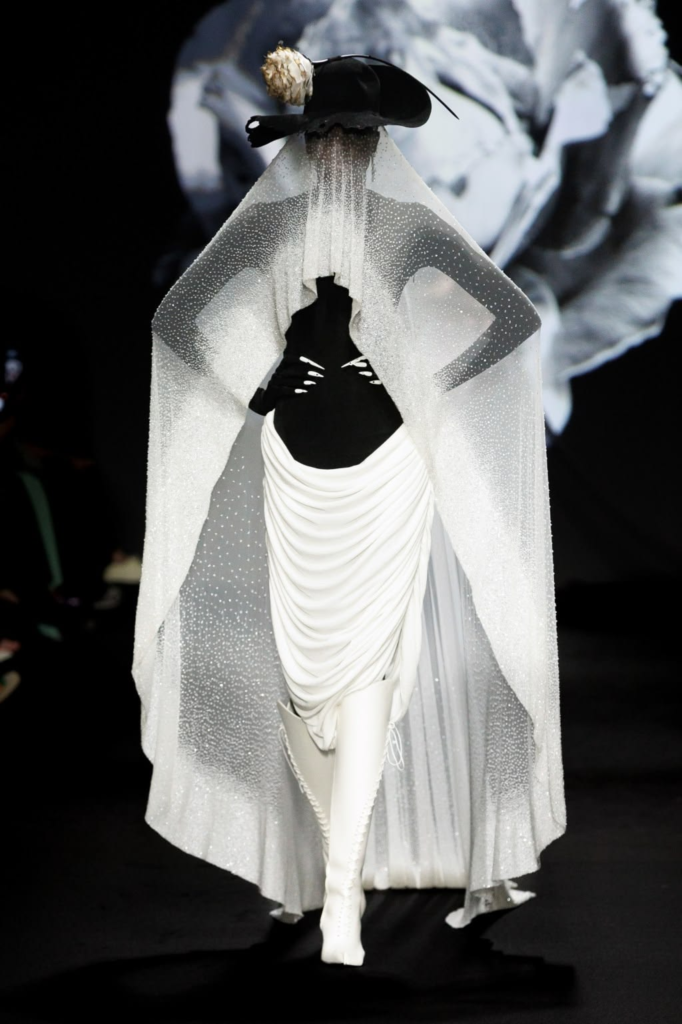
Robert Wun understands this better than almost anyone working today. His collections don’t reference the cathedral, they become one. Silhouettes fold and spiral like reliquaries, black stops being the absence of color and starts being the presence of something sacred. The garment doesn’t cover the body so much as confess over it.

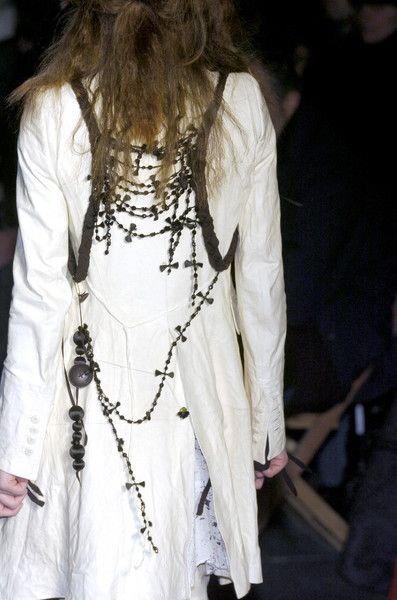
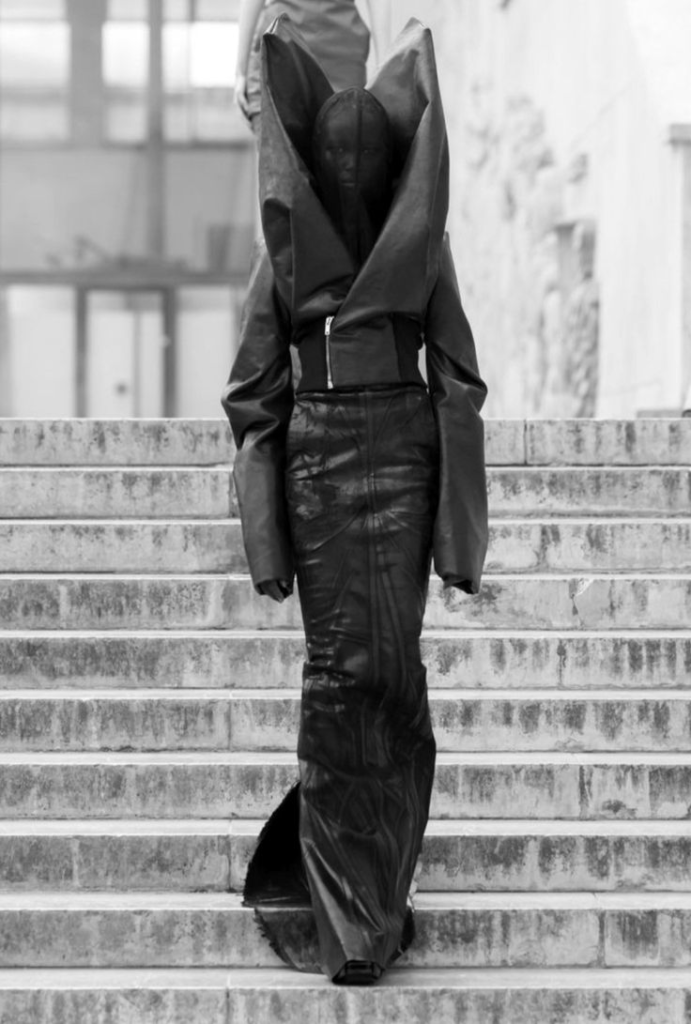
He isn’t alone in this liturgy. Ann Demeulemeester built an entire vocabulary on gothic romanticism decades before it had a name for it in mode circles, all trailing fabrics, poet sleeves and a melancholy worn like armor. Rick Owens took the same darkness and gave it mass, draping bodies in shapes heavy enough to look excavated rather than designed, glamour dug up from a ruin instead of sent down a runway. Between the three of them, neo-gothic stops being a mood board and becomes a genuine, continuous discipline.

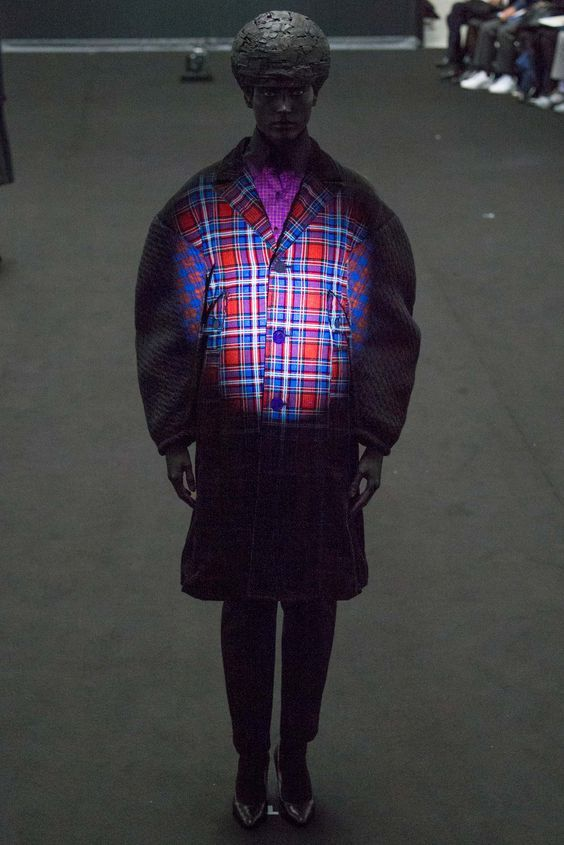
Robert Wun FW24
Ann Demeulemeester FW05
Rick Owens SS24

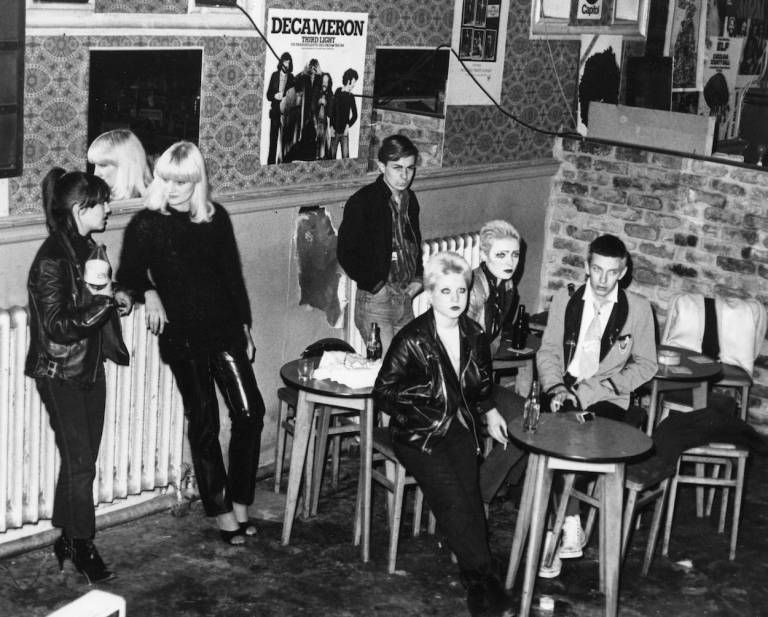
None of this is accidental, and none of it is new. Long before it reached the runway, this darkness lived on the margins, in the post-punk clubs of late-1970s Britain, a subculture built on refusal. What neo-gothic does now is smuggle that refusal straight into the temple of high fashion, without ever asking it to behave.

Punk Clubs of late 70s, Britain

Decay, here, is not the opposite of beauty. It’s where beauty goes to become permanent.

NEO-FUTURISM: THE HIGH-TECH UTOPIA

If neo-gothic asks to be forgiven, neo-futurism asks to be believed.

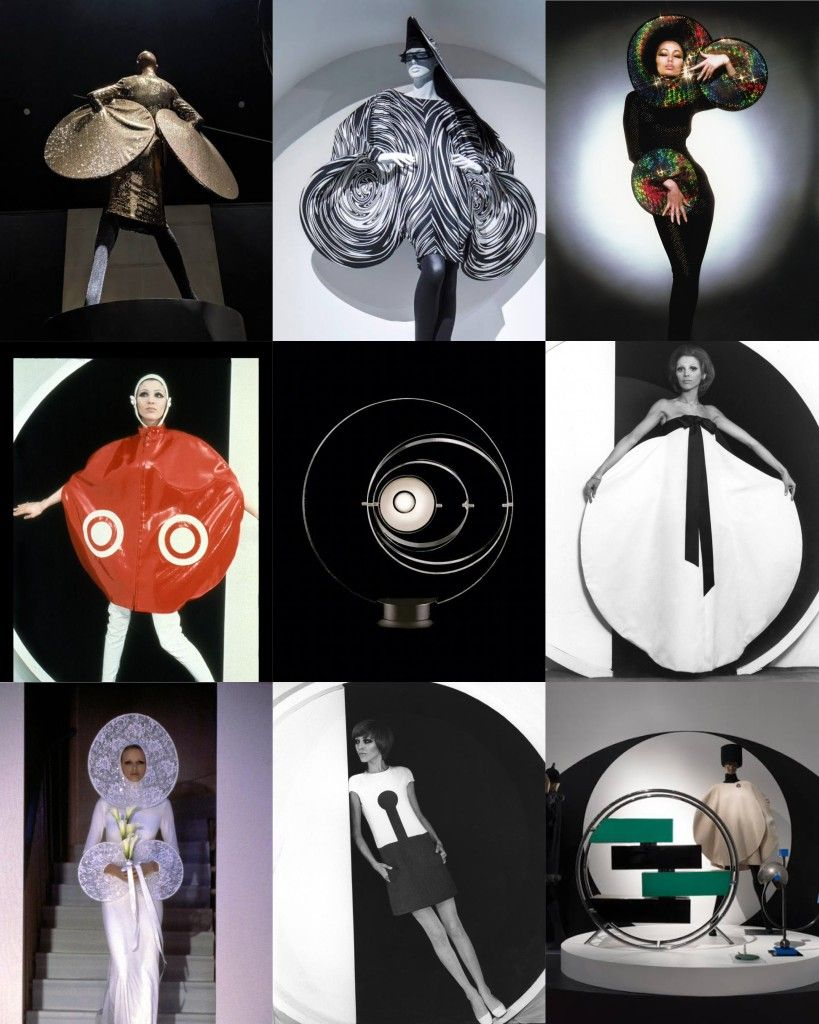
Its story starts in the sky, in a year the ground gave out. 1968 was assassinations, Vietnam, Paris under barricades, the Prague Spring crushed under Soviet tanks, a present that offered nothing left to believe in. Pierre Cardin’s answer was to leave it.

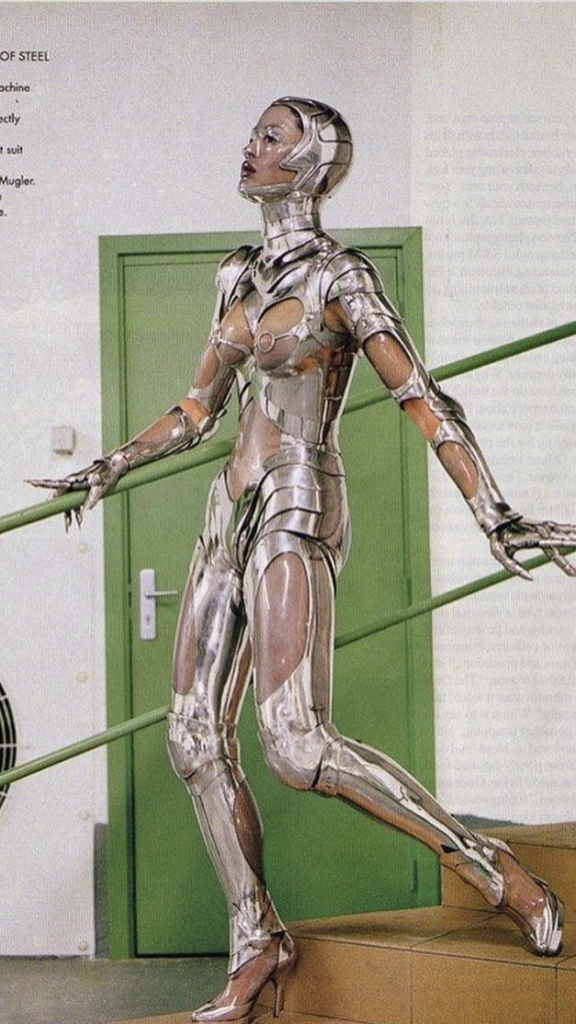
His Cosmocorps, a unisex, modular vision born from a decade obsessed with Sputnik and the promise that space was the next address for humanity, wasn’t escapism as decoration. It was fashion’s first real declaration that the future wasn’t a theme, but a destination. The present had stopped being livable. Thierry Mugler picked up that promise a decade later, in a moment that needed defiance more than escape. 1979 closed out a decade that had run out of money and nerve, oil shocks, stagflation, disco curdling into recession, and Mugler answered with excess instead of retreat: his Spirale Futuriste dressed the body in silver lamé cut to move like liquid metal rather than sit like fabric, armor against a present that had stopped being generous. His 1995 Robot Suit pushed the same logic to its limit, an exoskeleton of interlocking chrome plates that turned the model into a machine capable of walking, arriving just as cloning and genetic engineering were forcing the question of where the human body ended and its manufactured double began. Mugler’s future was never cold or sanitized, it was armored, erotic, built from the same material as desire.

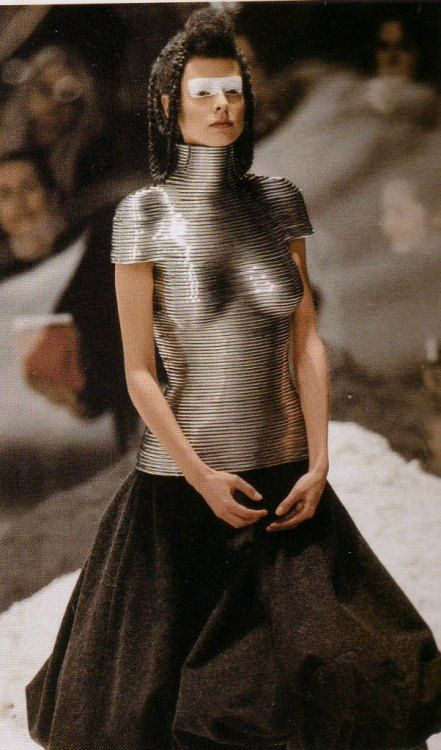
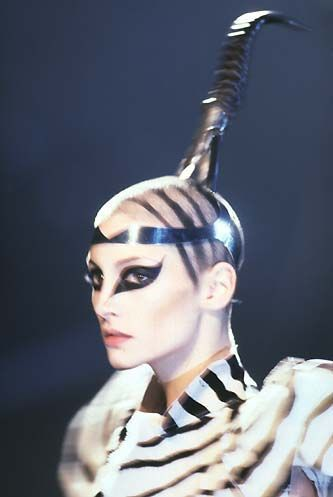
But an armored future is still a hopeful one. What McQueen did with his FW1997 collection was different in kind, not degree, it took Mugler’s promise of augmentation and inverted it into a threat. That season’s antelope-horn headpieces and metallic-ribbed bodices didn’t dress the body so much as graft onto it, technology read not as gift but as parasite, prosthetic beauty that costs something. Ten years on, Hussein Chalayan pushed that same body-as-apparatus logic past costume entirely, and it’s worth remembering what shaped him to look at instability this closely: a childhood split by the 1974 division of Cyprus, homes and identities redrawn overnight by a line on a map. That instinct for things that don’t stay fixed became engineering in One Hundred and Eleven, SS2007. The dresses on his runway were rigged with concealed telescoping mechanisms and motors that let each garment fold, extend and reconfigure itself in real time, in front of the audience, no hands involved, one silhouette dissolving into the next the way an identity does when the ground it stood on stops existing. This was no longer wearable technology dressed as fashion. It was engineering, wearing the disguise of couture.
Pierre Cardin SS68
Thierry Mugler FW79
Thierry Mugler FW95
Alexander McQueen FW99
Alexander McQueen FW97
Hussein Chalayan FW07
Hussein Chalayan SS07
Hussein Chalayan AW00

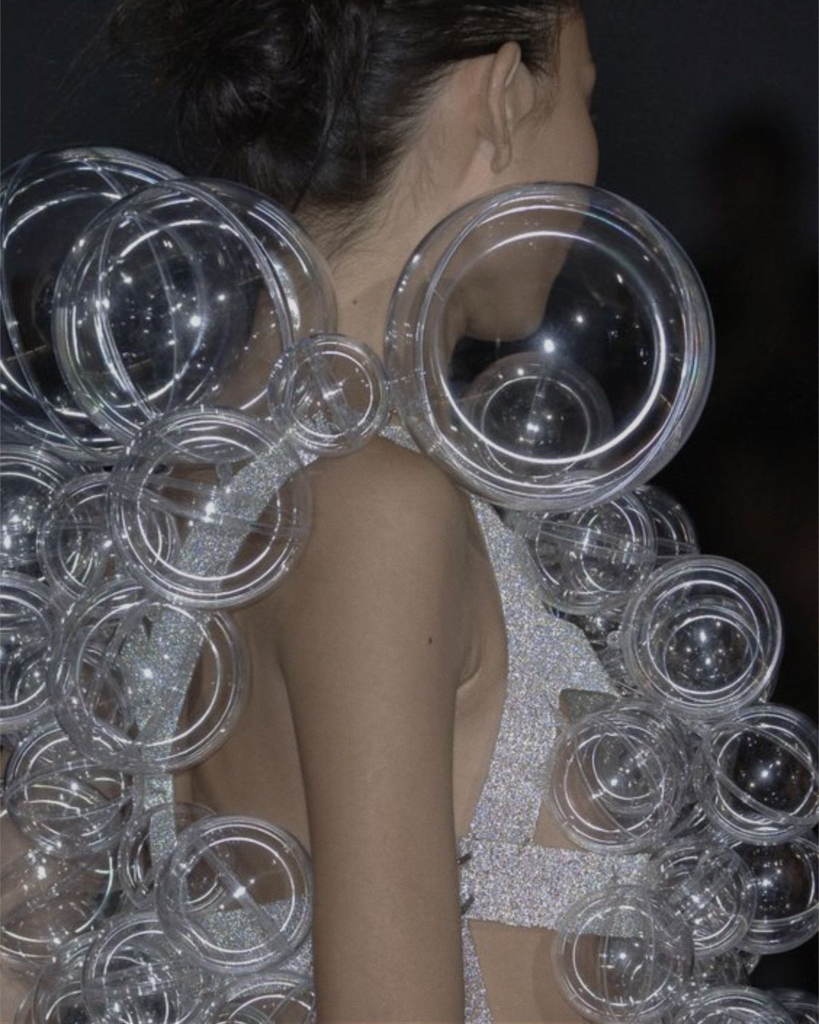
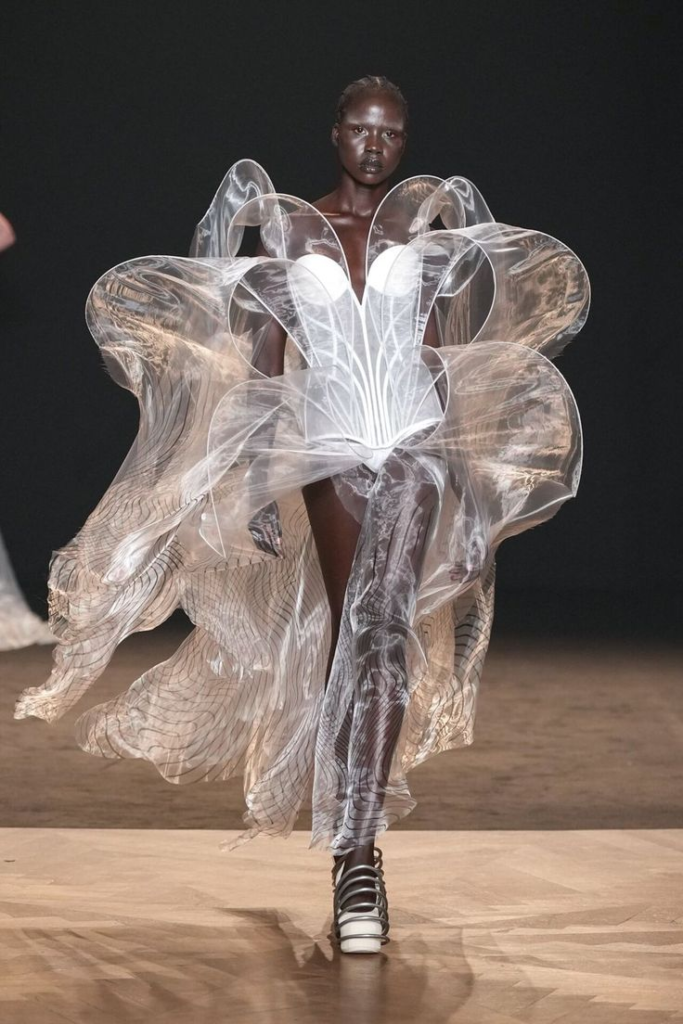
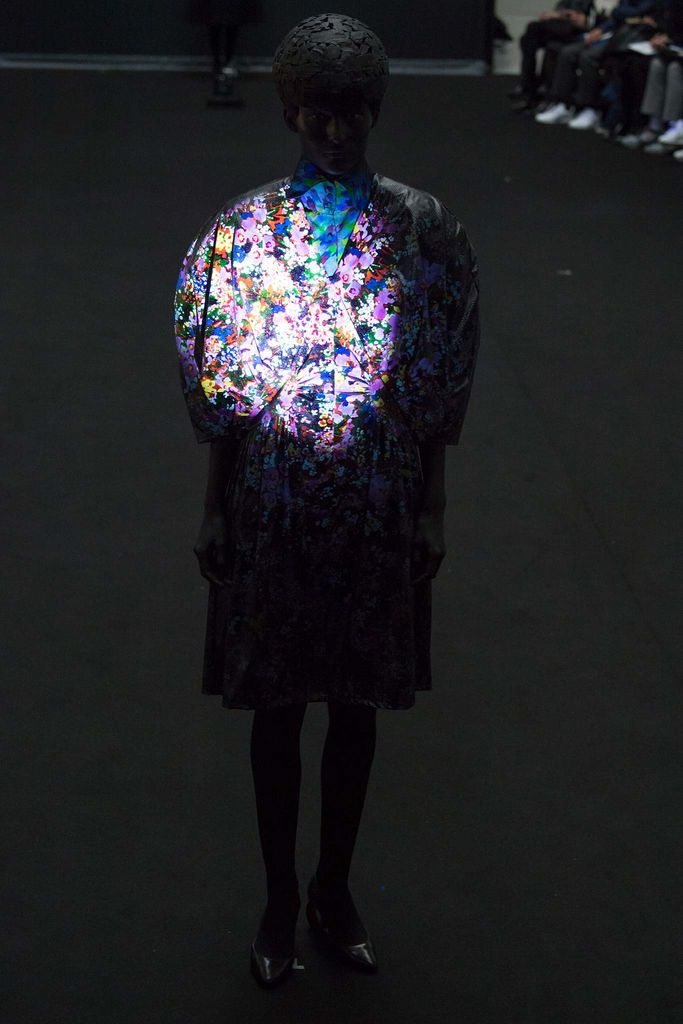
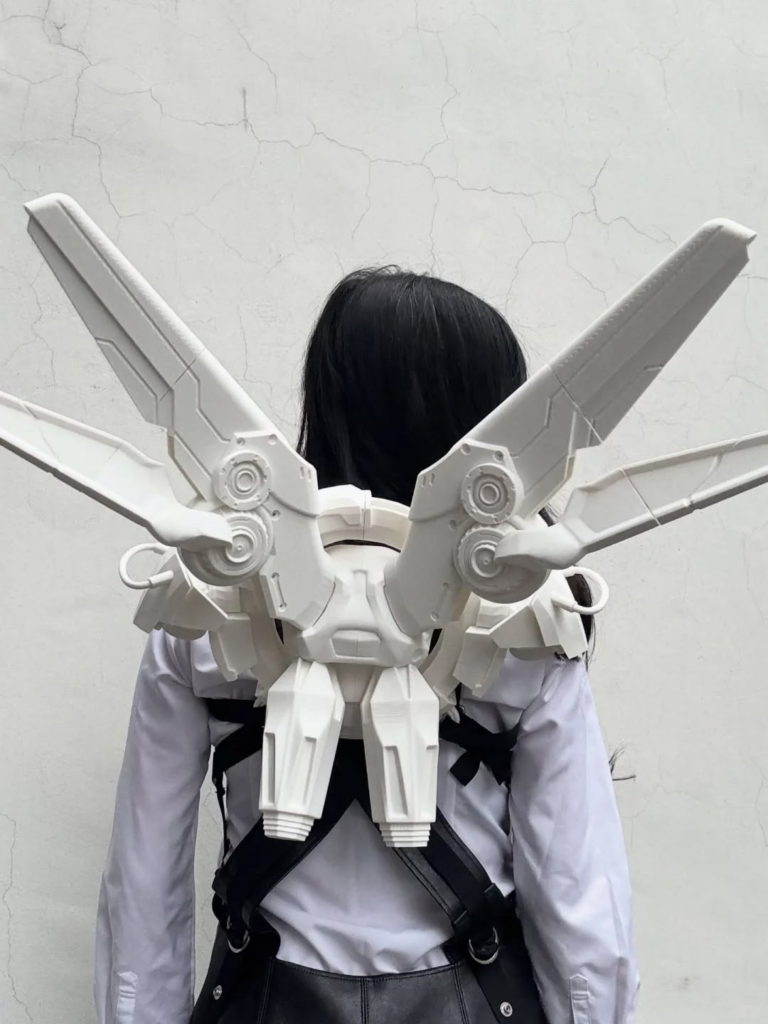
Where Mugler, McQueen and Chalayan built the future out of metal, motors and threat, the generation working now is growing it instead, answering a different collapse: a climate running out of time and a body increasingly rewritten by biotechnology. Iris van Herpen trades that old metal-and-plastic vocabulary for something cellular, almost biological: her 3D-printed structures are engineered layer by layer to mimic tissue and membrane, garments that look grown rather than built, as if the only future left worth trusting is one that behaves like nature instead of replacing it. Gaurav Gupta pushes the same organic logic toward light rather than texture, draping liquid-metal fabric so it catches and refracts until the body reads less like a machine and more like an icon, proof that neo-futurism, pushed far enough, circles back to the same sacred register as its gothic twin. Kunihiko Morinaga’s Anrealage goes further still, weaving photochromic pigments directly into the fabric so the garment shifts pattern and color on contact with UV light, meaning the piece doesn’t just exist under the runway lights, it visibly responds to them. And online, without a runway at all, creatives like @eomzie are prototyping that same imaginary through 3D-printed, articulated hardware, wing and jetpack rigs built for the body rather than around it.

Iris van Herpen FW25
Gaurav Gupta SS25
Gaurav Gupta SS25
Anrealage FW15
EomZie Robo Angel Wings Jetpack

From Cardin’s cosmos to Eomzie’s feed, neo-futurism has never stopped changing address. It has never once changed its destination: a future we can finally believe in, because we built it ourselves.

CONCLUSION

Two aesthetics, two directions, one refusal.

Neo-gothic dresses in ruins. Neo-futurism dresses in prototypes. One kneels before a past it never lived through, the other reaches for a future it may never arrive at, but both are doing exactly the same thing: turning away from now. Cathedral or spaceship, reliquary or exosuit, the destination doesn’t matter nearly as much as the direction, which is always away.

Maybe that’s the real function of avant-garde fashion in a collapsing present: not to predict the future, not to mourn the past, but to give us somewhere else to stand while the present sorts itself out. Robert Wun’s ruins and Chalayan’s machines aren’t opposites. They’re exit signs, pointing in opposite directions, out of the exact same room.

Credits

Written by Noa Chantemerle @noalitaa

Cover by @martinchiks

Welcome

E-mail
Password

E-mail *
First Name *
Last Name *
Age *
Gender *
Country *
City *
Phone Number *
Password *
Confirm Password *

E-mail
New password
Confirm new password