


Ophelia drifts, carried by the lazy current of an English river. Her body, motionless, barely seems to disturb the dark water that bears her. In John Everett Millais’s painting, she is both presence and absence: arms outstretched, hands open like offerings, she floats among the submerged weeds, her face turned skyward. Her white dress, weighed down by water, undulates on the surface like a delicate shroud, while scattered flowers encircle her inert body. The scene, bathed in an almost supernatural light, possesses a disturbing beauty. Ophelia does not struggle; she surrenders to the drift, accepting death with melancholic grace. In Shakespeare’s tragedy, she is the victim of a broken love, her body offered to the river as a final sacrifice. But in Millais’s version, tragedy falls silent: no more cries, no more tears, only the inexorable slowness of the water and the stark whiteness of her dress. Beauty becomes funerary, death an adornment, an image suspended between life and sleep.
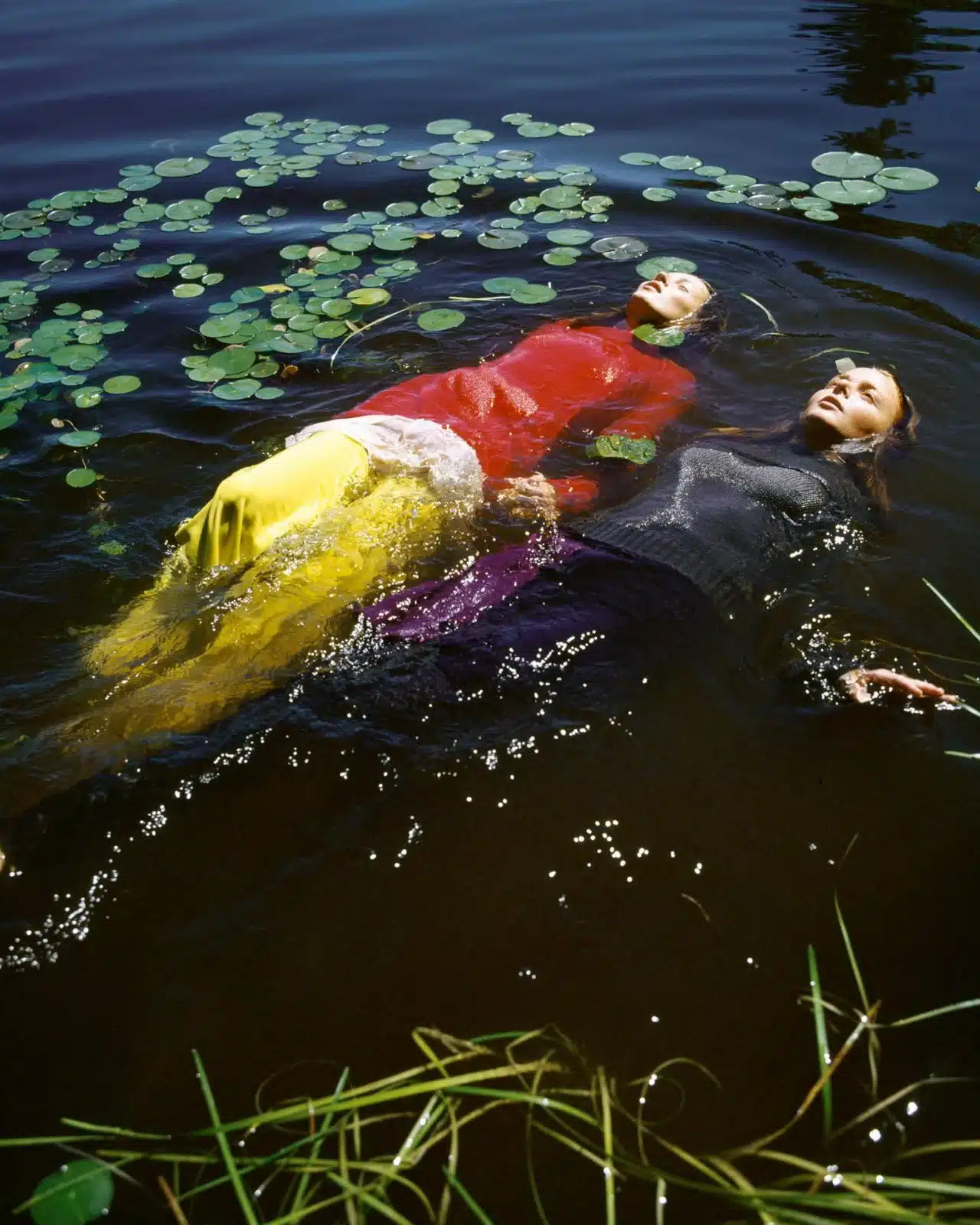
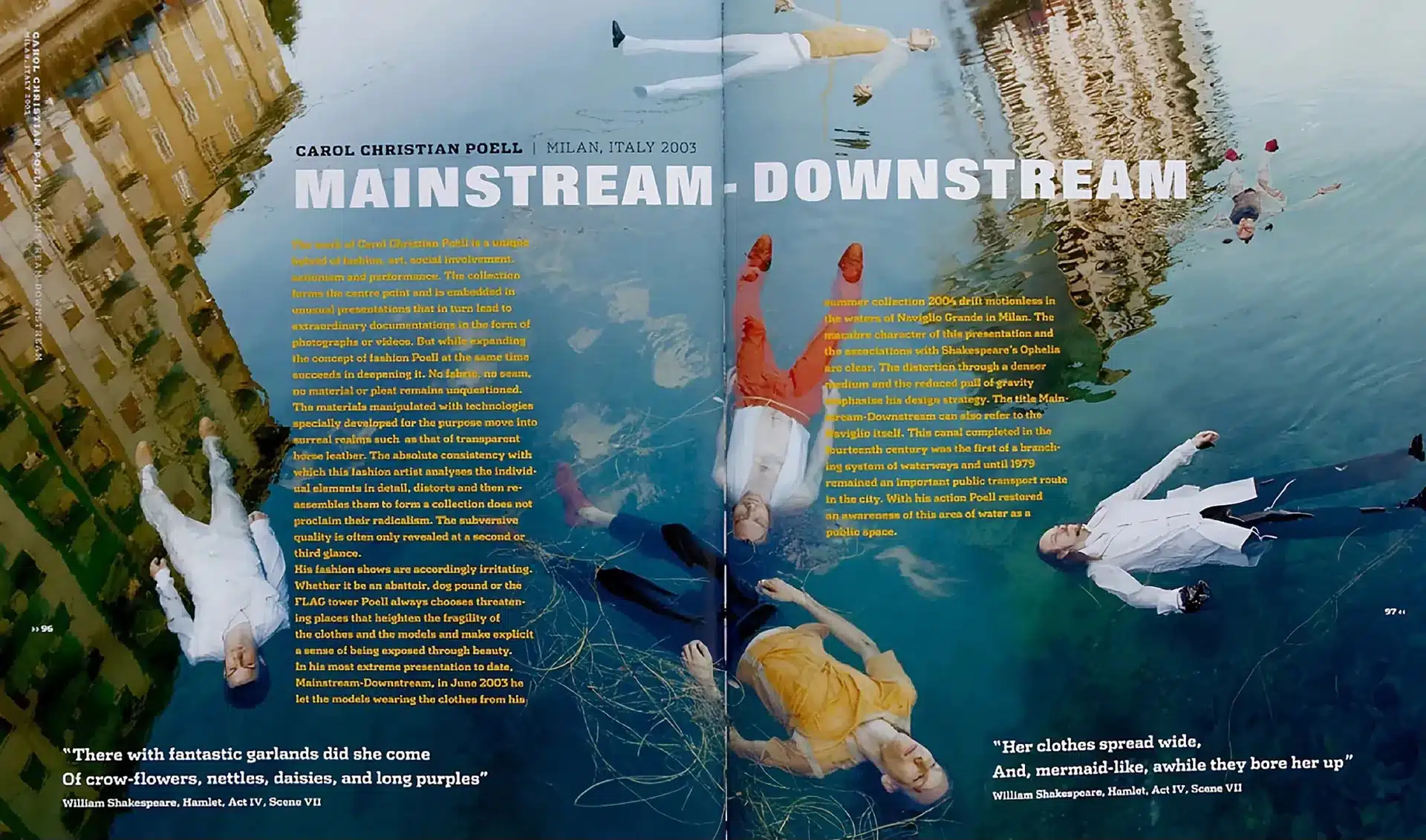
A similar vision appeared in June 2003, during the presentation of Carol Christian Poell’s Spring/Summer 2004 collection. Along the banks of Milan’s Naviglio Grande, spectators witnessed, somewhere between horror and fascination, an unexpected composition: a show against the current, completely outside of time, wholly unheard of. Upon the dark water, silhouettes drifted, arms outstretched, carried by the canal’s somber flow. There was a hypnotic slowness to the scene: a spectacle in which fashion stood still, letting itself be carried away, like a distant echo of Millais’s painting.
Seventeen models lined the water in an almost meditative stillness. Beside them, solitary garments floated, like suspended bodies untethered from the earth. Each was held afloat by concealed inflatable structures, seemingly at the mercy of the canal’s reflections and the gentle rhythm of its current. It was a vision where precision met drift. For all the severity Poell is known for, this presentation surrendered itself to the water’s randomness. The sharp tailoring of the jackets, the stark whiteness of the shirts, the weighted volume of the trousers, all were released from the command of a runway, carried instead by the current in a slow, wordless improvisation.
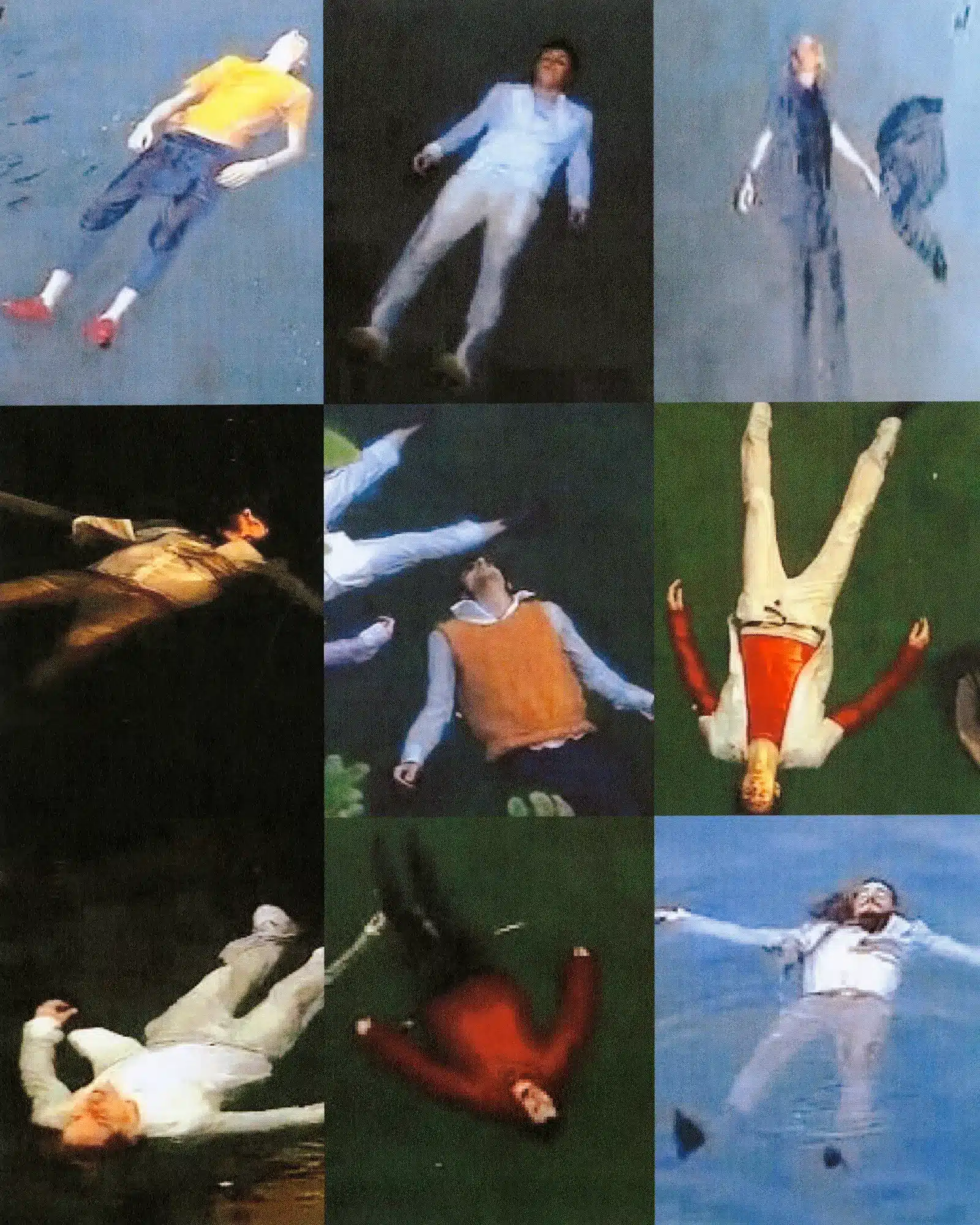
At first glance, the scene bore the marks of abandonment: clothes given to water, defenseless figures, a slow descent that might suggest ruin or waste. Everything in the image seemed to speak of an end. And yet, precisely in that moment, something shifted: fascination took hold. What drifts is no longer simply discarded; it becomes something to fixate on, to covet. Spectators’ gazes, initially uncertain, grew hungry, following each imperceptible sway, each fold that shimmered across the surface. The garment, freed from posture and display, became a precious fragment, a secret to be deciphered. There was, in that delicate shift, the strange alchemy where debris becomes desire, and ruin, relic.
In that moment, one nearly forgets that these are not just images but actual garments, creations each marked by the singular vision Poell defends: fashion that dares to constrain, to disrupt, to push toward the radical. For although the show did not present the coveted “Drip” pieces or his most mythical works, it highlighted something else, quieter but no less intense. The elastic meshes that encased the bodies evoked both protection and captivity, like a hybrid between chainmail and straitjacket. The belts, strapped tight around the waist, disrupted expected lines, reinforcing the silence, imposing an attitude, a discipline, a bearing made all the more powerful by the bodies’ slow drift. And then, perhaps the most startling detail, the soleless red boots: shoes never meant to walk, but to float, as a final renunciation of purpose, that of deliberate movement.
Thus, at the edge of randomness and obsession, Poell sketches an art where control and forfeit blend into a single gesture. Fashion, laid bare, is no longer a declaration of conquest. It becomes an ephemeral offering, a quiet ritual in which artifice admits its own vanity. Poell’s creations remind us that beauty is never more piercing than when it agrees to vanish. The canal, complicit in this mise-en-scène, holds on to nothing; it simply reveals what matters most: the strength of a garment that gives itself freely, without striving for movement, without chasing triumph or speed, and finds its magnitude in the instant of its carelessness, yet, in surrender, ascends into legend.
Credits:
Written by Aaron Daulne @doyle.bel_