Published on April 17, 2026

We explore Elsa Schiaparelli’s relationship with Surrealism, from collaborations with artists like Dalí to how Daniel Roseberry’s recent collections reinterpret those codes for a contemporary audience.

Coco Chanel once dismissed her rival Elsa Schiaparelli as “that Italian artist who makes clothes.” Schiaparelli herself might have agreed. Unlike Chanel, who cast herself as a craftswoman of utility and restraint, Schiaparelli treated fashion as an art form, and it was perhaps this very stance that kept her from becoming a household name in the same way.

Born in Rome in 1890 to an aristocratic family steeped in scholarship, her father a professor of medieval and Islamic studies, her uncle a renowned astronomer, her second cousin the Egyptologist who discovered Nefertari’s tomb, Schiaparelli grew up surrounded by ideas and curiosity. As a young woman, she wrote poems on Greek mythology and cultivated a fascination with ancient ritual. Her parents, seeking to tame her imagination, sent her to a convent school and arranged a marriage to a wealthy Russian. She rebelled, fleeing to London, where she married a fraudulent psychic. By 1916, she had relocated to New York and given birth to a daughter. When her husband abandoned her, she was left to reinvent herself.

In New York, she encountered avant-garde circles through Gabrièle Buffet-Picabia, wife of Francis Picabia, and mingled with Man Ray and Duchamp. Dada and Surrealism’s irreverence, eroticism, and dream logic remained with her. By 1922, she had moved to Paris, briefly assisted Man Ray, and even attempted to launch French couture in America. The project failed, but under the mentorship of Paul Poiret, she began experimenting with her own designs.

Her breakthrough came in 1927 with a hand-knit black sweater adorned with a white trompe l’œil bowknot. Surrealist in its trickery, yet practical to wear, it announced her entry into Parisian couture.

Trompe l’œil bow sweater, Schiaparelli, 1927

Through the 1930s, Schiaparelli blurred the lines between garment and artwork. Her most celebrated collaborations were with Salvador Dalí, whose theatrical imagination mirrored her appetite for provocation. Her autobiography was aptly titled Shocking Life.

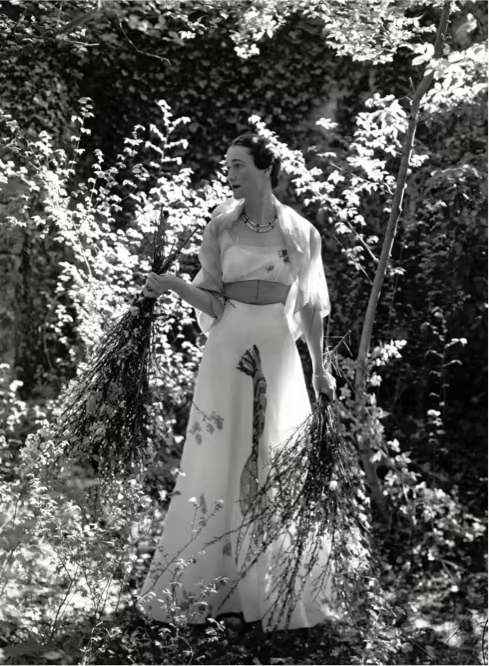
The most notorious of their creations was the lobster dress of 1937: a silk evening gown with a crimson waistband and a large lobster painted by Dalí across the skirt. Already a sexual symbol in his art, the crustacean was positioned between the wearer’s legs. Wallis Simpson wore it for Cecil Beaton shortly before her marriage to Edward VIII, scandalizing and captivating society in equal measure. Later, author and illustrator Ann Shen called it an emblem of “the power of innovation and sexual empowerment in a woman, and the impact that art and fashion can have.”

Wallis Simpson wearing Schiaparelli’s lobster dress, photographed by Cecil Beaton, 1937
“Fashion: Summer’s Catch,” Vogue, Vol. 89, Iss. 10, (May 15, 1937): 86, 87

Other inventions expanded her Surrealist vocabulary: the shoe hat, a high-heeled pump inverted on the head; the skeleton and tears dresses, playing with death and rupture; a lamb chop hat, trivial turned absurd; and a day suit with drawer-like pockets that literalized hidden storage. With Jean Cocteau, she created an evening jacket embroidered with a woman’s silhouette—hair cascading down one sleeve, hand encircling the waist—and a coat with mirrored profiles doubling as a vase of flowers. These were not novelties but provocations, questions in cloth about the body, desire, and perception.

Shoe Hat. Schiaparelli, 1937
Embroidered jacket by Schiaparelli and Cocteau, 1937
Skeleton Dress. Schiaparelli, 1938

Surrealism’s preoccupation with dreams and subconscious liberation resonated deeply with Schiaparelli. Just as the movement emerged from the disillusionment of World War I, her garments offered escape from rationalism and convention. Dalí invoked Freud’s definition of a hero as the one who overcomes the father. Schiaparelli, defying her parents’ strictures, used eccentric design as her rebellion.

If her couture was too radical for mass appeal, her perfumes made Surrealism accessible. Shocking!, with its Mae West-inspired bust bottle, became an icon that prefigured Gaultier’s Classique. Sleeping came in a candlestick bottle; Le Roy Soleil, designed by Dalí, celebrated Louis XIV; Snuff, marketed to men, slyly referenced Magritte’s pipe.

“Shocking!” Perfume advertisement, 1937

After World War II, austerity and a turn toward simplicity eroded her clientele. In 1954, she closed her house, though perfumes lingered. By her death in 1973, she was remembered less as a fashion success than as a visionary cult figure.

For decades, the maison lay dormant, more legend than reality, until sporadic revivals in the 2010s failed to capture its spirit. Its true rebirth came in 2019 with Daniel Roseberry, a 33-year-old Texan with no couture training but a decade under Thom Browne. The expectations were immense: could anyone awaken the myth?

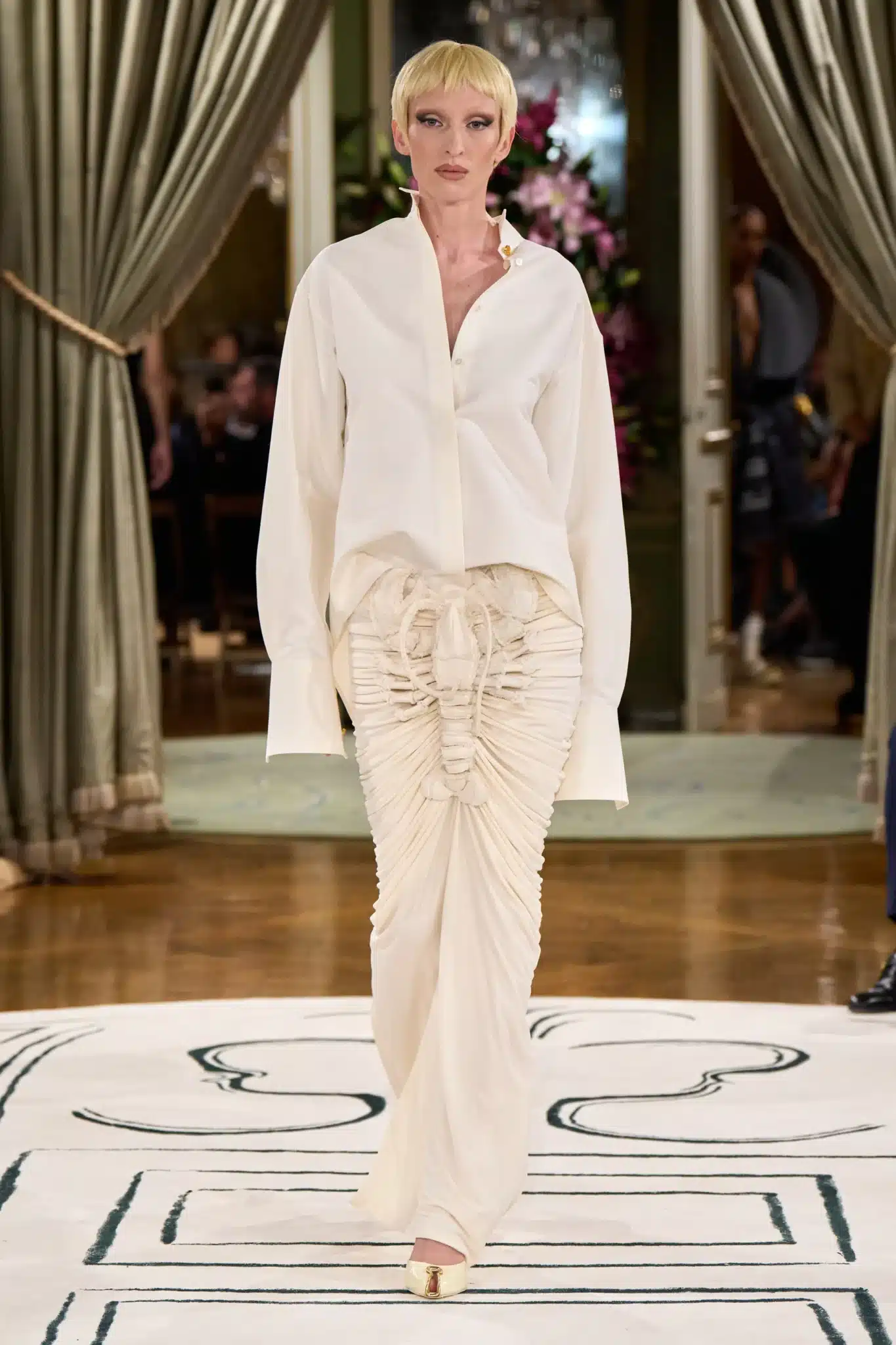
Where Bertrand Guyon leaned on homage, Roseberry reactivated Surrealist codes for a digital century. His Fall 2021 collection, The Matador, reimagined Schiaparelli’s 1940 boleros and Cocteau motifs through the lens of 1980s excess and painterly grandeur. For years, he avoided the lobster, calling it overused, until Spring 2024, when he revived it with a twist: lobster earrings, necklaces, and a ruched skirt crowned by a sculptural crustacean at the crotch, deliberately courting both awe and unease.

An elegant reimagining of the bolero. Schiaparelli, FW2021
Lobster Redux Skirt. Schiaparelli, SS2024

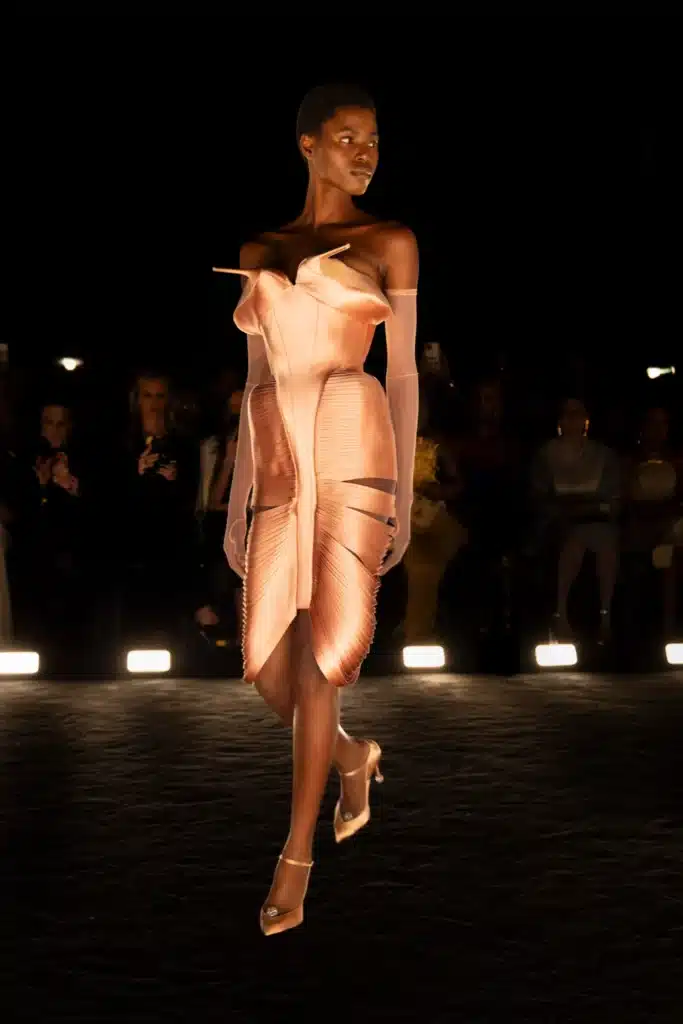
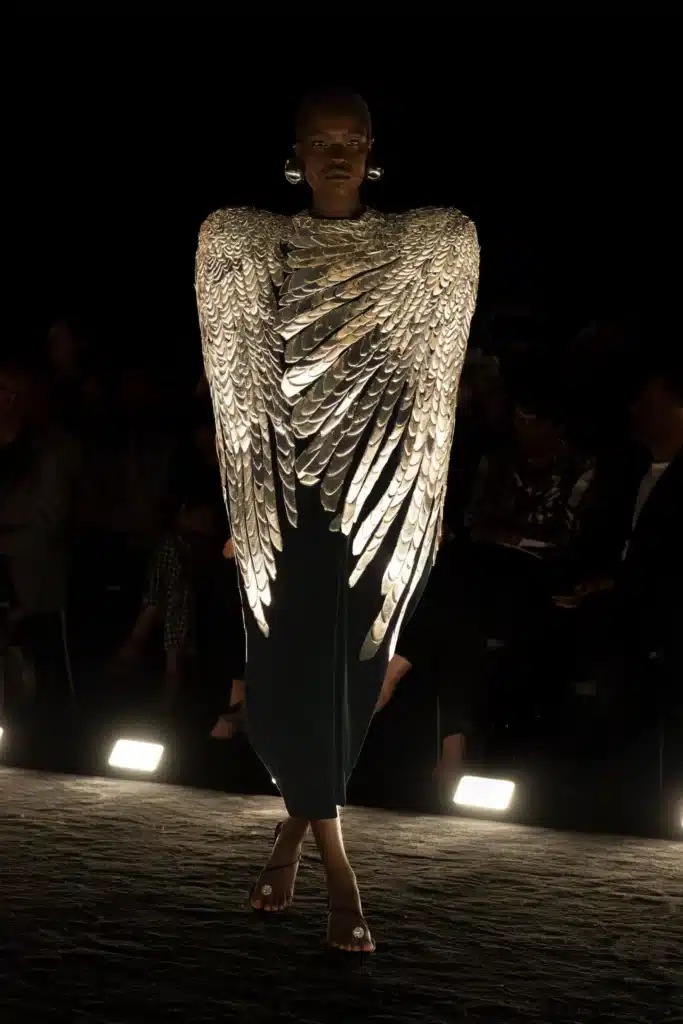
In Fall 2024’s The Phoenix, he staged resilience through a corset echoing the shoe hat and a velvet cape with winged shoulders, suggesting rebirth. By Fall/Winter 2025–26, his theatrics reached new heights: a rhinestone-encrusted beating heart protruded from a false back torso, reversing the model’s body and unsettling the audience.

Shoe corset. Schiaparelli, FW 2024
Winged cape. Schiaparelli, FW2024
Dress with inverted torso and rhinestone heart. Schiaparelli, FW 2025

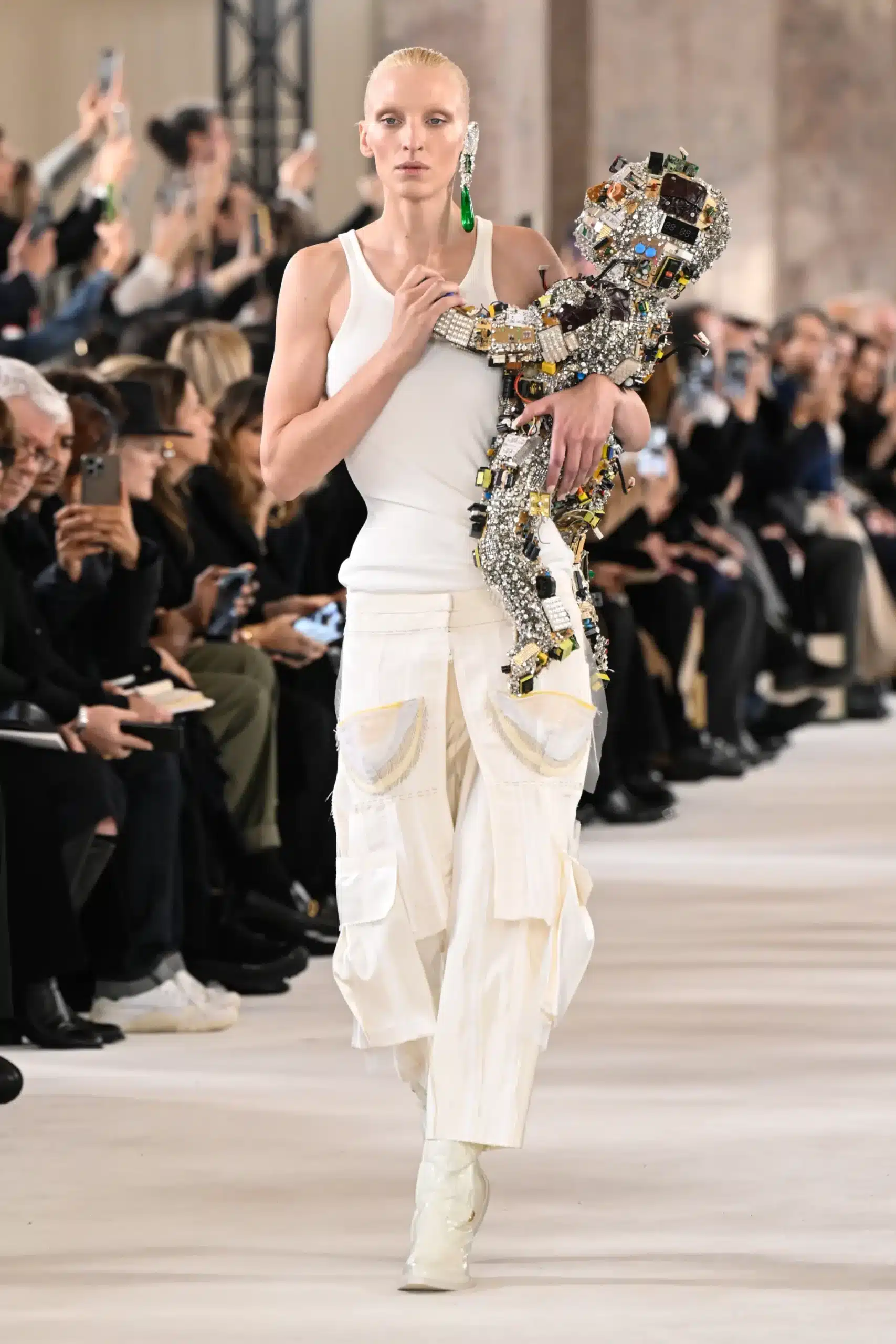
What sets Roseberry apart is not only technical bravura but also his instinct for translating Surrealist disturbance into the currency of images. Schiaparelli is credited with pioneering fashion shows accompanied by music, making spectacle part of couture. Roseberry extends that into the age of virality: his robot baby from Spring 2024 was as much performance art as garment, engineered to dominate timelines as well as runways.

Robot baby from Spring 2024.

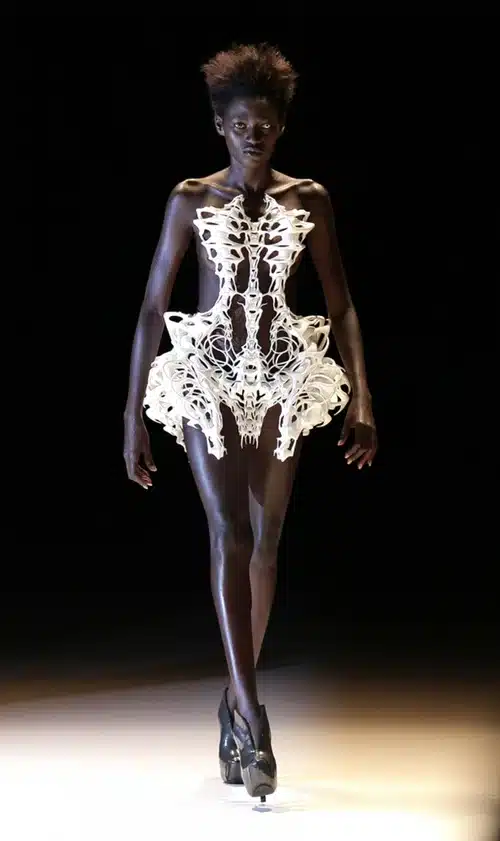
Yet the question lingers: when shock is expected, can it still unsettle? The skeleton dress has been endlessly reinterpreted, from McQueen to Iris van Herpen, its original radicalism diluted. Surrealism itself, once scandalous, has been absorbed into luxury branding. Perhaps the true provocation today lies not in spectacle, but in insisting that fashion remain irrational, poetic, and resistant to mere function.

Spine corset by Alexander McQueen SS98
Iris van Herpen Skeleton, FW2011

Roseberry’s Schiaparelli embodies that paradox. His collections stage dream logic and absurdity while acknowledging that every outrage is quickly aestheticized and archived. Like Elsa, he works as an artist disguised as a couturier, demanding that clothes transcend utility.

Today, her influence feels inescapable. From McQueen to Viktor & Rolf to Iris van Herpen, designers who treat fashion as spectacle owe her a debt. The V&A’s Schiaparelli retrospective, now open in London, underlines her role as the patron saint of fashion as art.

Whether Surrealism can still disturb in the 21st century is uncertain. But Roseberry’s work suggests that radical imagination, even a rhinestone heart or lobster at the crotch, retains power to destabilize the ordinary, if only for a moment.


Credits

Written by Nacho Pajin

Welcome

E-mail
Password

E-mail *
First Name *
Last Name *
Age *
Gender *
Country *
City *
Phone Number *
Password *
Confirm Password *

E-mail
New password
Confirm new password