Published on May 23, 2026

Hair has always carried meaning beyond adornment. It is a language of ancestry, divinity, and resistance. Through Yoruba philosophy, African ritual, and contemporary fashion, this piece explores how the act of styling -braiding, covering, shaving- becomes both memory and message, both art and prayer.

The head as a portal

Before we speak, our heads are already saying something. Our entire bodies are instruments of nonverbal communication, pulsing with messages, and hair is among the most expressive and codified parts.

In many African cultures, the head and hair are sacred. In the Bashi tribe in the Eastern Congolese region of Kivu, my grandfather has watched hairstyles cycle over time, from women shaving their heads and tracing them with symmetrical shapes, to intricate braiding, to the rising presence of wigs as Western beauty standards circulate. Hair reflects the evolving, interconnected global culture.

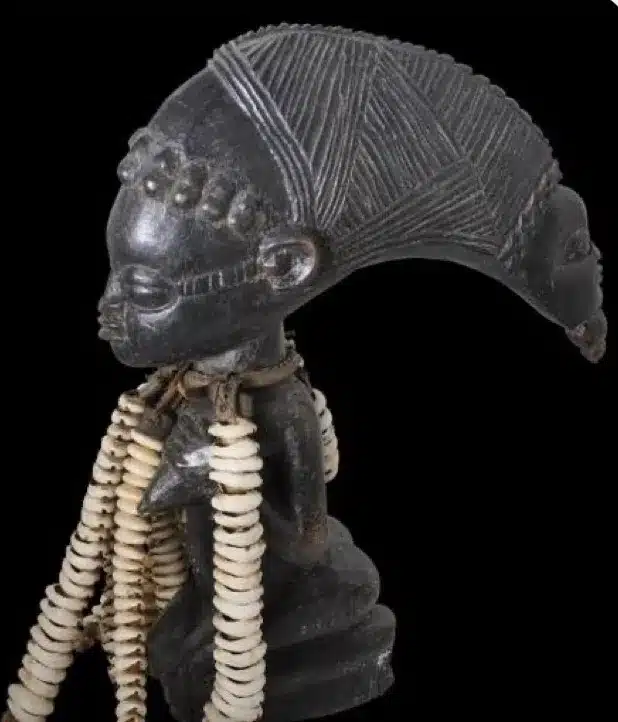
In West African Yoruba philosophy, the concept of Orí (head) is vital. It is considered not only as the physical head, but as the seat of one’s spiritual essence and destiny, a portal. Orí is prevalent in Yoruba culture, making sprinkled appearances throughout its mythology, art, and ethics. It is deemed the most important part of the body and is often depicted disproportionately large in traditional sculpture to reflect this. And rightfully so, as the carrier of one’s wisdom, destiny, and selfhood.


Hair as aesthetic philosophy

Ajíbóyè et al. (2018) approach Orí as a lens into Yoruba aesthetic thinking, tracing its depiction in ritual, decoration, and language. Aesthetics, they argue, emerge from the same belief systems that shape values and spirituality. What we find beautiful is never separate from what we believe.

Building on this, Abíọ́dún (2014) defines ẹwà (beauty) as inseparable from ìwà (character). True beauty lies in ìwàpẹ̀lẹ, a moral and spiritual coolness. A culture’s aesthetics, then, reflect a way of being. Abiodun (1990) outlines five core qualities that shape ìwàpẹ̀lẹ.

Yoruba aesthetic theory holds that when these qualities align, true coolness, and thus true beauty, is attained. This applies not only to art but to the body. Braiding, head coverings, and adornments also express this system where ethics, self-control, and spirituality are inseparable from beauty.

Ajíbóyè et al. (2018) go further, turning to the act of hair weaving itself. In Yoruba tradition, the act of braiding is not neutral. It requires consciousness. All five qualities of ìwàpẹ̀lẹ are necessary to successfully divide the hair and execute the design. Like old stories, braiding techniques and muscle memory are passed down generationally. Here, the act of braiding is a ritual labor. A braid done by a knowing hand meticulously shapes destiny.

And perhaps this is true across cultures. Perhaps any aesthetic act, when done with intention and memory, is a form of ceremony.

Yoruba Eshu Figure, circa 1900
Carved wooden figure of Eshu Elegba

Cultural codes in contemporary fashion

But what happens when these symbolic systems are lifted from their original context and reappear, abstracted, on Western fashion runways?

McQueen’s 2000 ready-to-wear collection Eshu is named after the Yoruba deity of chance, duality, and disruption. In Yoruba cosmology, Eshu is a mediator in spiritual communication. He moves between realms: earth and spirit, order and chaos, joy and despair. His form is fluid: in some depictions male, in others female, or somewhere in between. Eshu is not just an isolated figure, but a constant presence in Yoruba cosmology, sculpture, and proverbs. To invoke him is to touch an entire spiritual system.
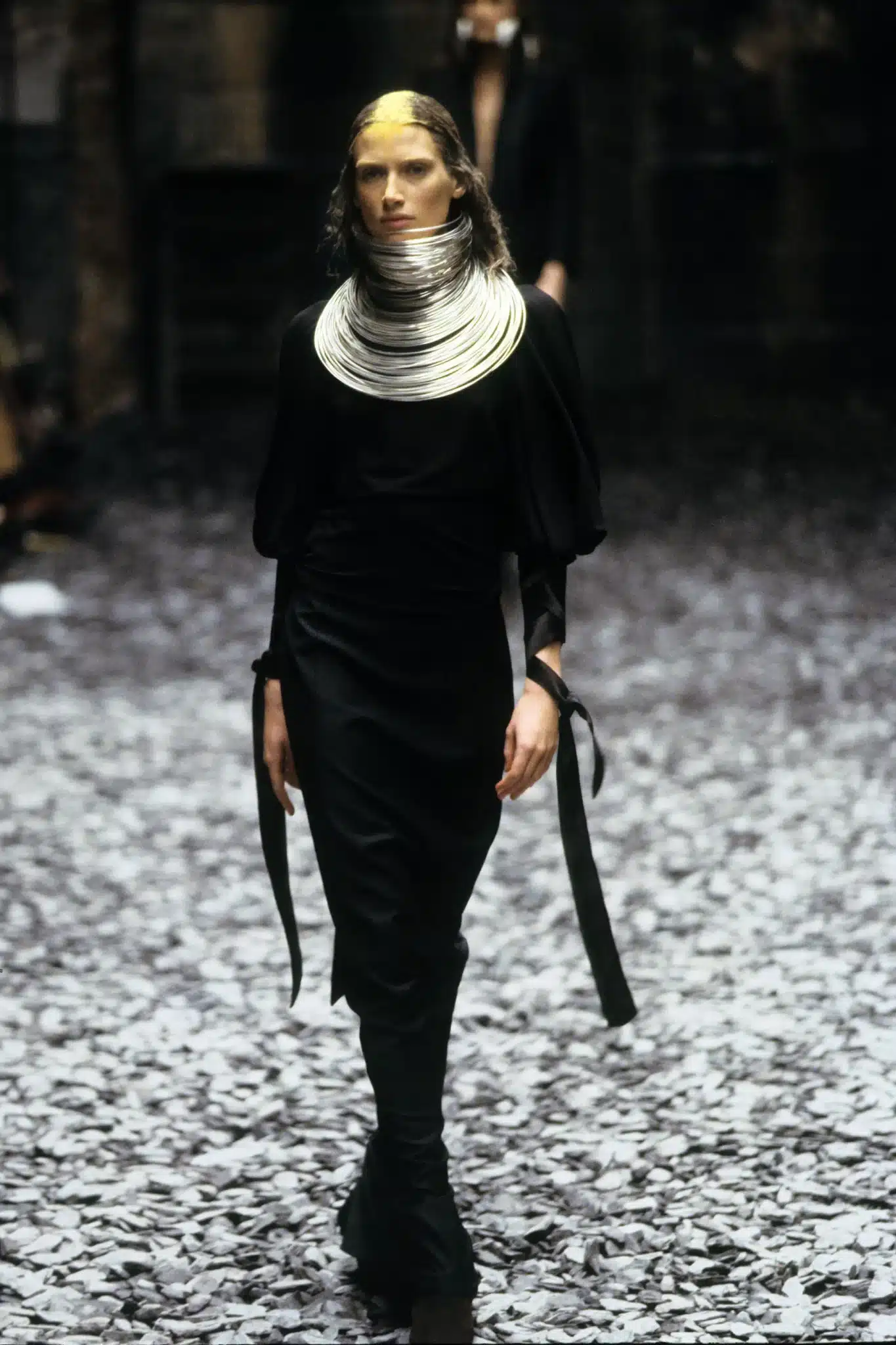
Alexander McQueen, FW2000

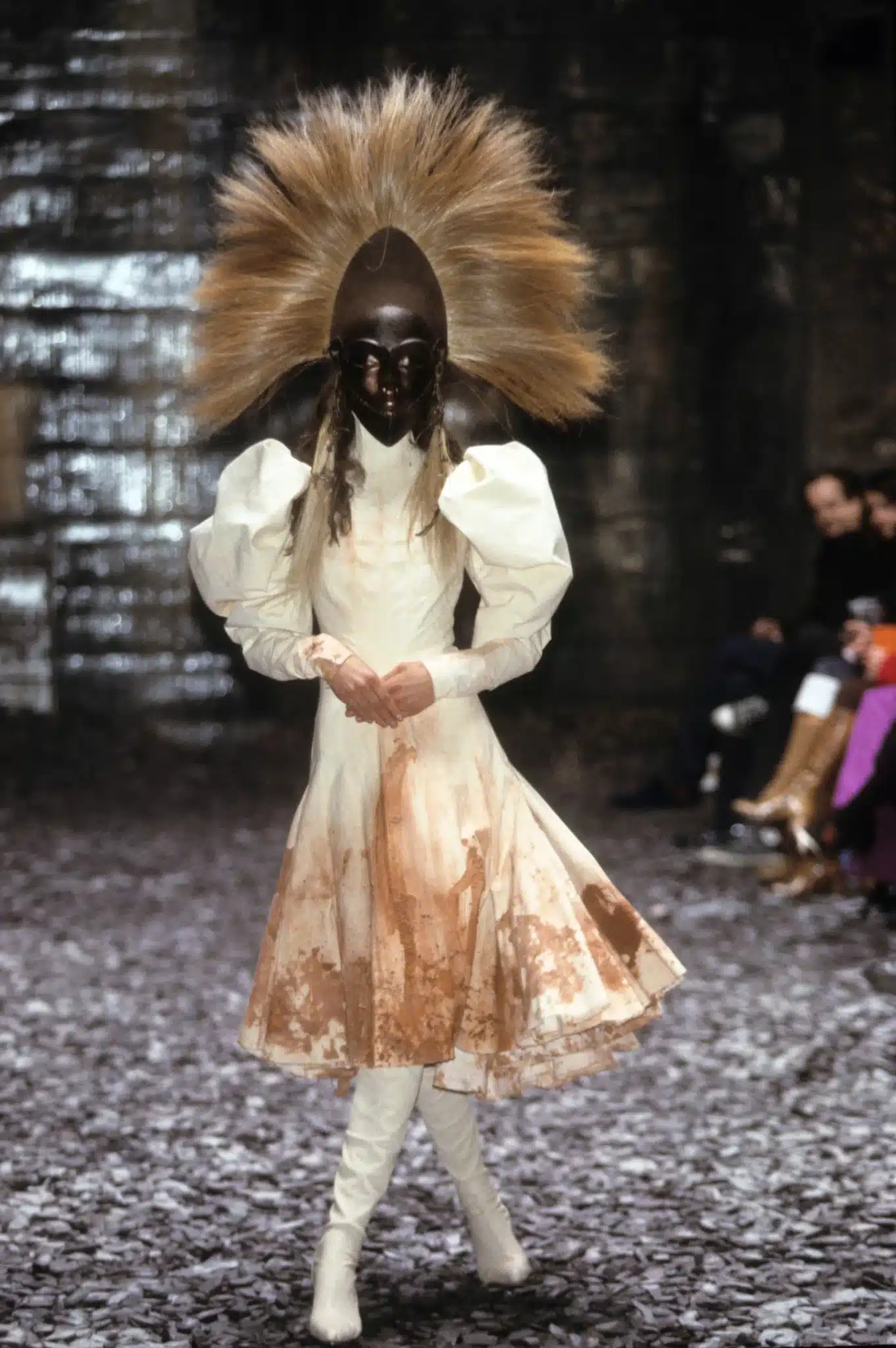
Though McQueen’s Eshu collection did not try to explain this deity, it did conjure something. Hair became sculpture. Horsehair, a significant material in Yoruba ritual objects, was stitched into coats and headdresses, heads covered with a thick, muddy paint. But Yoruba culture was not consistently present in the collection, despite what the title implied. Other details like stacked necklaces hinted at ritual somewhere, but were not culturally specific. For those familiar with Yoruba or other African visual languages, the collection might conjure confusion. Barbara Steinberg (2025) calls Eshu a self-portrait of McQueen’s own chaos. The scattered use of lip plates, piercings, and beadwork makes the collection feel like a fantastical cherry-pick of African symbols rather than a reflection of Yoruba deities.

Alexander McQueen, FW2000

And yet, something survives. McQueen’s collection, unstable and layered, is resounding and still pantomimes Eshu’s in-betweenness. His work was often deeply personal, and here he seems to use unanchored symbols of “Africa” not to interpret Yoruba cosmology, but to externalise his own intrigue and disruption. But we quickly learn that a symbol alone might not carry true meaning without the systems that sustain it. Even something as seemingly simple as hair is part of a complex cultural code. Any given style is embedded with values, rituals, and beliefs.

Fashion often turns culture into symbol, and ritual into aesthetic. Slow, round, generational meaning is flattened into image. The resulting creation is not meaningless, but its meaning shifts. A strand of horsehair stitched into a coat may allude to cultural symbols, but without the spiritual framework or community to interpret it, its power becomes ambiguous. Open to beauty, yes, but also to misreading.

Alexander McQueen, FW2000

Fashion tends to choose the present over the past, reassembling symbols into new forms rather than faithfully representing tradition. Some may see this as creative evolution, others as cultural dilution. Maybe meaning survives reassembly, but who controls that transformation, and what is left out of its retelling?

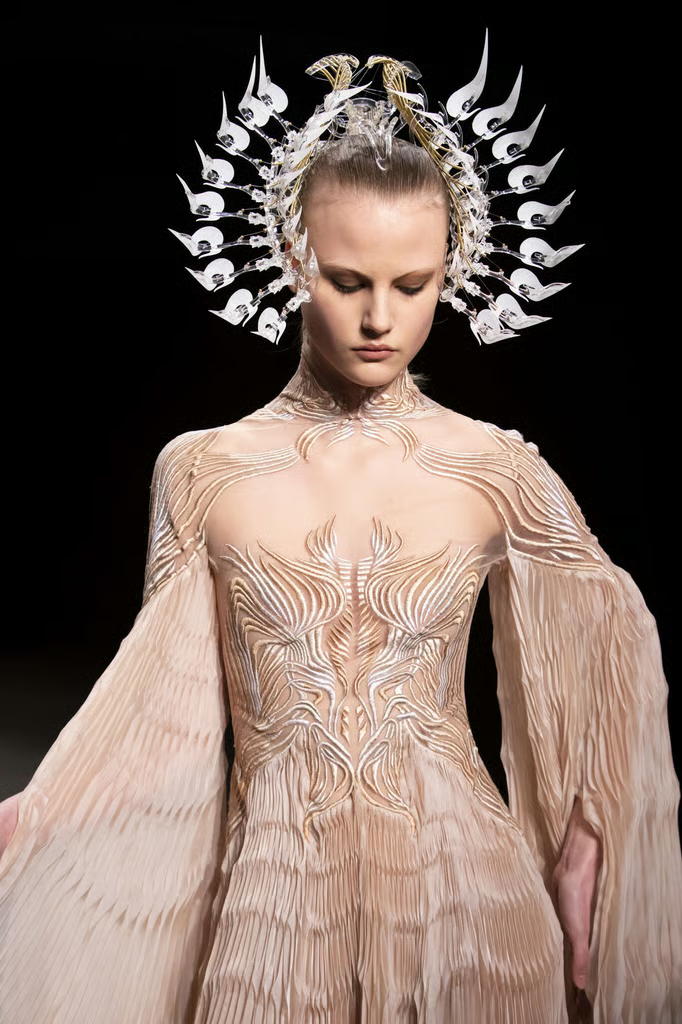
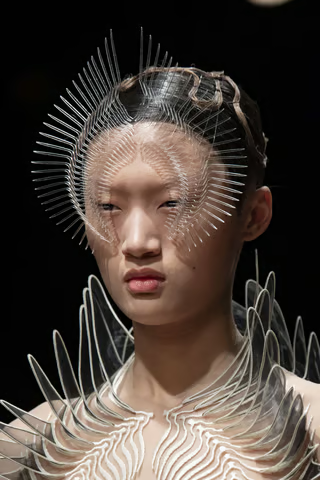
This complex interplay between hair, meaning, and reassembly appears in other works as well. Junya Watanabe’s structuralist headpieces, made with hairstylist Katsuya Kamo, draw from traditional Japanese paper folding and architecture. Iris van Herpen sculpts hair into organic spirals that mirror fungal networks and uses 3D-printed hair-like elements, blending technology with nature to create hair that is both ancestral and futuristic. Both designers turn hair into speculative material that is part culture, part physical world, part future, and part memory.

Iris van Herpen, SS2021
Iris van Herpen, SS2020
Iris van Herpen, FW2015

What hair knows

Depictions of hair, and all aesthetic details, are belief systems made visible. A hairstyle knows things and says things. If we listen, we can make out stories of knowledge preservation, social roles, and spirituality. Of queerness, of lineage, survival, and rebellion.

Cornrows have been used to communicate escape strategies during the slave trade and as a hidden storage system for rice during colonial rule. In traditional Fulani culture, a hairstyle is a region, a ceremony, or a rite of passage. Different styles and adornments signal life stages. A close haircut might mark a newly married man. Metal head ornaments are worn for courting during market days. The more glittering the headdress, the more desirable the boy.

Hair is also practical. Nigerian Fulani nomad women often have elaborate braids framing the sides and back of the head, while the top is kept free to carry head loads. Chonmage, the original topknot worn by samurais in feudal Japan, lives on today in sumo wrestlers. Previously a practical hair choice, it is now a symbol of discipline and cultural identity. Sikh turbans, called dastaar, carry profound spiritual meaning and identity, symbolizing altruism, honor, and commitment across generations.

Fulani hairstyle

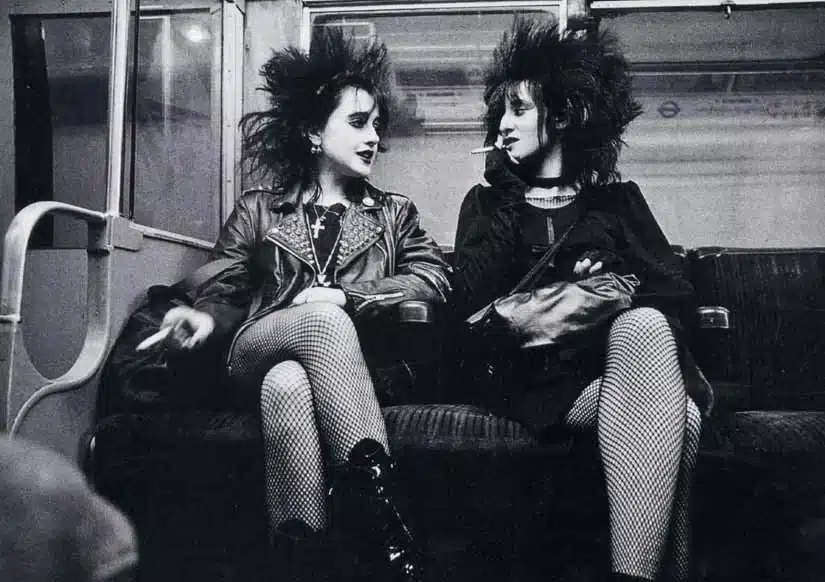
During the American and British punk rebellion of the 1970s, hair was a scream. Hairstyles were extensions of anger, alienation, and rebellion, with safety pins, shaved heads, and neon spikes. Punk hair derailed natural order, saying “I don’t belong here and I don’t want to.” Hair is also a playground for gender, where binaries are often softened and reimagined.

 
Punk Girls in the tube, 1982
Punks wearing Dr. Martens in the 1980s

Wispy edges, afros, buzz cuts, dyed tips, mohawks, head coverings, and dreadlocks often come from modes of spiritual, social, and cultural engineering. They mumble and scream our values and histories back to us. Fashion often communicates through hair, but sometimes its codes rely on the contexts that give them depth. Without understanding these roots, hair risks being seen as mere decoration rather than the complex, deeply coded language it truly is.

Credits 

written by Zaina Pakabomba @zigggyp

Welcome

E-mail
Password

E-mail *
First Name *
Last Name *
Age *
Gender *
Country *
City *
Phone Number *
Password *
Confirm Password *

E-mail
New password
Confirm new password